Intellectual Preparation, Part 1: Why It Matters
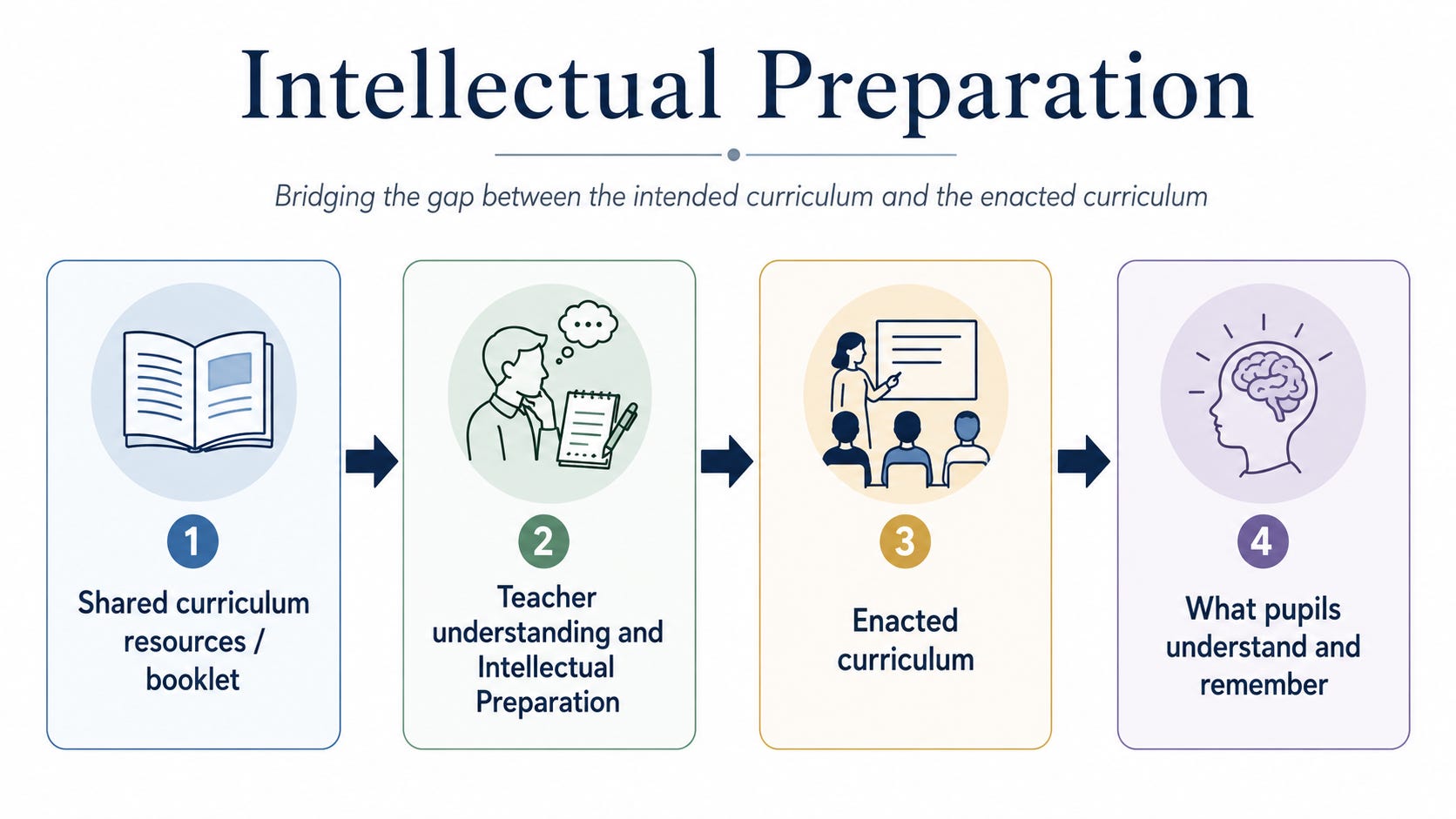
Why shared curriculum resources are only as strong as teachers’ understanding of them, and why Intellectual Preparation helps bridge the gap between the intended curriculum and the enacted curriculum.

In my previous post, I argued that curriculum booklets can be valuable, but that their success depends on much more than the booklet itself. As I wrote there, “a booklet may provide the common resource, but it is Intellectual Preparation that enables the teacher to bring it to life.” This post picks up that point by exploring what I mean by Intellectual Preparation, why it matters, and why it becomes particularly important when teachers are working with booklets, shared curriculum materials or centrally produced resources. However, while Intellectual Preparation may become more visible in these contexts, I would argue that it is good practice for any effective teaching.
Lawrence Stenhouse’s argument that “curriculum development must rest on teacher development[1]” is useful here. It captures something central to Intellectual Preparation. A curriculum is only as strong as teachers’ collective understanding of it. However carefully a curriculum has been designed, it still has to be understood, interpreted and enacted by teachers in classrooms.
Drawing on Bauersfeld’s[2] distinction between the matter meant, the matter taught and the matter learned, we can think about curriculum at three levels: the intended curriculum, the enacted curriculum and the achieved curriculum. The intended curriculum is the carefully designed learning journey we want pupils to experience. The enacted curriculum is what actually happens in classrooms: the explanations, questions, tasks, adaptations and interactions through which that curriculum is taught. The achieved curriculum is what pupils ultimately know, understand and can do.
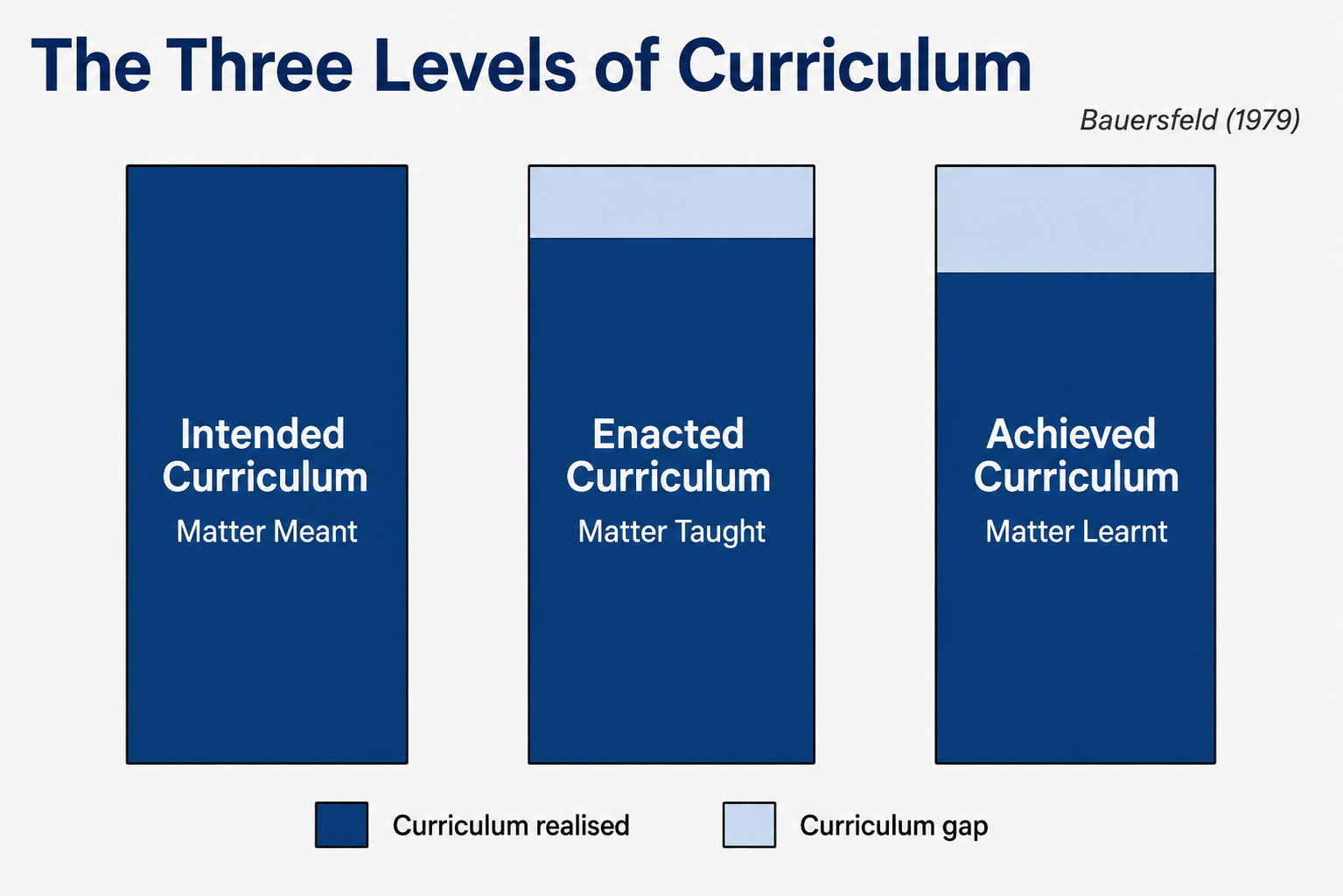
This distinction matters because there is always the possibility of a gap between these levels. What is intended is not automatically enacted as planned, and what is enacted is not automatically learned by pupils. This is where Intellectual Preparation becomes important. It creates space for teachers to step back and think deeply about the subject: why this content matters now, how it connects to what has come before and what is still to come, where pupils are likely to struggle, how understanding will be checked, and how the curriculum will be brought to life in the classroom. In this sense, IP is not just preparation for an individual lesson. It is part of teacher development because it strengthens teachers’ understanding of the curriculum they are enacting.
1. Why Intellectual Preparation matters — and why it needs to be named
In doing some background reading for this post, I found that the phrase Intellectual Preparation appears to be more common in US and Australian curriculum implementation discourse than in UK academic literature. It is not absent from the UK, however. There are examples of the term being used in school and trust documentation. Ark Academy, for example, talks about teaching being built on a foundation of Intellectual Preparation[3], while Ark Soane’s curriculum overview explicitly references Intellectual Preparation as “vital for effective curriculum delivery”[4], linking it to teachers’ ability to communicate complex knowledge, anticipate where pupils may struggle, and adapt booklets through departmental co-planning. Other examples include The Regis School’s teaching and learning handbook[5] and Co-op Academy Florence MacWilliams’ curriculum implementation material[6]. It is also possible that similar professional thinking exists elsewhere under different terms, particularly where schools talk about curriculum enactment, subject knowledge development, co-planning, lesson study, rehearsal or collaborative planning.
My own interest in Intellectual Preparation is rooted in professional experience, particularly my previous role as National Geography Lead at Astrea Academy Trust. I did not only experience Intellectual Preparation as part of the trust’s approach; I was also involved in delivering it and producing resources to support it as part of the development of the new KS3 Geography curriculum. I should be clear, however, that I am certainly not claiming to be an authority on Intellectual Preparation, nor am I suggesting there is one settled model of what it must look like. My thinking here is shaped by that professional experience, alongside the reading and examples I have been able to find, and by my wider thinking about pedagogy, adaptive teaching and curriculum enactment. Given that there appears to be relatively little UK literature that deals explicitly with IP as a distinct concept, others may frame it differently or use different language to describe similar professional work.
The elements that make up Intellectual Preparation are not new. One response to the phrase might be: isn’t this just part of teaching and what we do anyway?’. There is of course truth in that. Many aspects of Intellectual Preparation are key features of effective teaching: thinking about what pupils already know, considering the questions you might ask, anticipating where pupils may struggle, and thinking carefully about how best to explain particular concepts.
However, I do think the term is useful because it gives a collective name to a particular kind of professional work that can otherwise remain invisible. It is too important to leave to an assumption that it is happening simply because teachers are planning lessons. If we are serious about minimising the gap between the intended curriculum and the enacted curriculum, then the process of Intellectual Preparation is key. So too is the professional discourse around what effective Intellectual Preparation actually entails. If Intellectual Preparation helps teachers teach better, and helps pupils learn better, then why would we not want to engage in serious professional conversations about it? It should not simply be left as an implicit expectation of what teachers somehow do in their planning time because that is “just good teaching”. If it matters, it needs to be named, valued, discussed and protected.
We also need to be clear that Intellectual Preparation can be distinct from lesson planning, although that is not to say it sits entirely outside lesson planning. Lesson planning often involves deciding what will be taught, how it will be sequenced, and what resources or activities will be used. Intellectual Preparation as I see it comes after, or alongside, that work. It is the deliberate professional thinking about how the curriculum will be taught, enacted and adapted for the pupils in front of us.
That distinction matters particularly in schools or trusts where shared curriculum resources, centralised materials or booklets are being used. In those contexts, the teacher may not be starting with a blank page. The broad curriculum sequence, core explanations, resources and tasks may already exist. However, this also means that the teacher may not have been directly involved in all of the curriculum thinking that sits behind the lesson. They therefore need time and support to understand not just what is being taught, but why it is being taught in that way, at that point in the sequence, and for that particular purpose.
A centralised curriculum is not, and should never be considered, “plug and play”. It does not remove the teacher’s professional agency or responsibility. The teacher remains in control of the enacted curriculum: how the lesson is brought to life, how pupils are engaged in the content, how explanations are made clear, how understanding is checked, and how teaching is adapted in response to the class.
This is where the professional work shifts from creating the resource to preparing intellectually to teach it. That means understanding the purpose of the lesson, the geography at stake, the likely misconceptions, the key explanations, the questions that will reveal understanding, and the adaptations that may be needed for a particular class.
Where Intellectual Preparation is taken seriously, it becomes part of the professional culture. Teachers are given time to read, think, discuss, rehearse, adapt and prepare intellectually, not just produce or tweak resources.
This has been central to the work on Intellectual Preparation at Astrea Academy Trust. Led by the trust’s Head of Teacher Development for Secondary, Lindsey Bennett, Astrea’s approach focuses on three levels of Intellectual Preparation: Trust-level IP, led by Subject Leads; department-level IP, led by Subject Leaders; and teacher-level IP, carried out by individual teachers as they prepared to teach specific lessons. Importantly, Trust-level and department-level IP are not simply additional expectations placed on teachers; dedicated time is provided for them within directed time.
2. So what actually is Intellectual Preparation?
Intellectual Preparation is the deliberate professional thinking teachers undertake before teaching. It helps teachers understand the curriculum, anticipate how pupils are likely to respond, plan for misconceptions, and prepare to teach the lesson as effectively as possible.
Put another way, Intellectual Preparation is where the planned curriculum is internalised by the teacher. It is where we move from having a resource, sequence or lesson plan to being ready to teach it: understanding the rationale, the subject content, the likely difficulties, and the decisions that may need to be made during the lesson.
At its heart, Intellectual Preparation is about internalising the content we are going to teach[7]. It involves taking time to understand not only what we are teaching, but why we are teaching it, how it fits within the wider curriculum, and how pupils are likely to encounter it. It is where teachers bring together knowledge of the content and knowledge of their pupils in order to make informed decisions about how all pupils can access, think about and understand the material.
It is also helpful to think about Intellectual Preparation as a form of second-order thinking[8]. First-order thinking is often about immediate action: what am I going to do? Second-order thinking asks: and then what? If I explain it this way, what might pupils misunderstand? If I ask this question, what might it reveal? If pupils struggle with this task, what will I do next? If I scaffold this too heavily, what ceiling might I unintentionally create?
This matters because teaching itself involves significant cognitive load. In the moment, teachers are managing explanations, questioning, behaviour, pace, pupil responses, misconceptions, transitions, task completion and checks for understanding. It is difficult to do all of that well if the intellectual work has not already begun before the lesson. Intellectual Preparation creates space to fine-tune how the lesson will be taught, to build or strengthen content knowledge, and to anticipate the decisions that may need to be made once the lesson is underway.
This is particularly important where teachers are working with shared or centrally produced resources, such as the curriculum booklets I discussed in my previous post. Shared resources can free teachers from spending so much time deciding what to teach or creating materials from scratch. But that time should not simply disappear. Used well, it can be redirected towards deeper engagement with the curriculum resource: understanding its purpose, considering how it will meet the needs of a particular class, and deciding how best to teach the content.
This point is also supported by the Grattan Institute’s Ending the Lesson Lottery report[9], which argues that high-quality shared curriculum materials can reduce workload and support student learning. Crucially, though, the report also emphasises the need to strengthen curriculum expertise and support teachers to adapt materials effectively for their students. That is where Intellectual Preparation matters. Shared materials may provide the curriculum structure, but teachers still need time and professional development to understand, adapt and enact them well.
Essentially, a shared resource can mean teachers spend less time on what to teach and more time preparing how to teach it. This is not about moving away from the resource, but about engaging with it more deeply. It is about making decisions about how pupils will interact with the material, what they will need to think hard about, how understanding will be checked, what explanations and questions will be needed, and what the teacher will do if pupils do not yet understand.
Sarah Larsen[10] makes a similar point in a recent LinkedIn post reflecting on lesson planning as Intellectual Preparation. She notes that resources, slide decks and materials may be necessary, but they are still tools. The crucial questions are about what pupils will be thinking hard about, where their attention needs to be, how meaning and understanding will be checked, and what explanations and questions will support learning. That captures something important: the resource matters, but it is the teacher’s intellectual preparation that enables the lesson to become more than the resource itself.
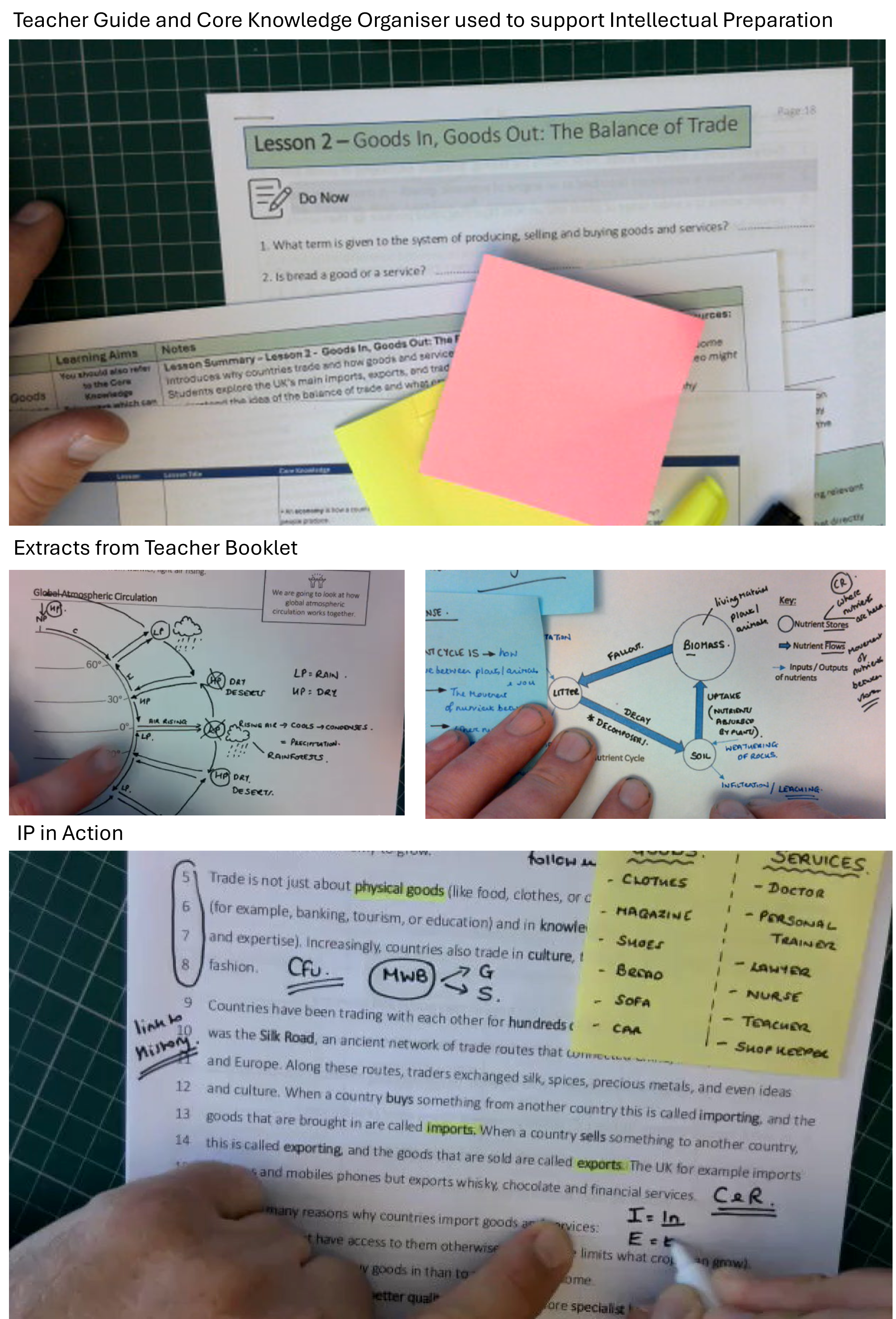
Please do follow up by reading Part 2 - What Intellectual Preparation involves in practice
[1] Stenhouse, L. (1975) An Introduction to Curriculum Research and Development. London: Heinemann.
[2] Bauersfeld, H. (1979) ‘Research related to the mathematical learning process’, in Steiner, H.G. and Christiansen, B. (eds) New Trends in Mathematics Teaching, Vol. IV. Paris: UNESCO, pp. 199–213.
[3] https://arkacademy.org/curriculum/our-approach/design
[4] https://arksoane.org/curriculum/our-approach/design
[5] https://www.theregisschool.co.uk/Portals/0/Curr%2025-26/TL%20Handbook%202025-2026%20V1_0.pdf?ver=a7Y5vm4O7CLDNz_DydDf_A%3D%3D
[6] https://www.florencemacwilliams.coopacademies.co.uk/page/?pid=261&title=Curriculum+Implementation
[7] https://www.fishtanklearning.org/teacher-support/blog/power-of-intellectual-prep/
[8] https://tbeeblogs.wordpress.com/2022/06/19/intellectual-preparation-our-second-order-thinking/
[9] https://grattan.edu.au/wp-content/uploads/2022/10/Ending-the-lesson-lottery-Grattan-Report.pdf
[10] https://www.linkedin.com/posts/sarah-larsen-209649215_tentatively-beginning-to-think-about-my-lessons-share-7465430993932480512-UoOW/?utm_source=chatgpt.com