Professional Development That Changes Practice
Reflections on Rachel Ball’s researchED Yorkshire session: the mechanisms of professional development that make classroom change more likely

Rachel Ball’s session at ResearchED Yorkshire focused on how knowledge of great teaching and learning can translate into meaningful change in the classroom. More specifically, it explored the evidence-informed mechanisms of professional development that are most likely to change teacher practice.
Too often, professional development is judged by whether it has happened: whether the session was delivered, whether staff attended, whether the slides were shared, or whether the strategy appeared on the improvement plan. Sometimes a simple evaluation form is used to gauge how useful staff found the session, or how confident they feel afterwards. Teachers may then be encouraged to reflect on the ideas and try to use them in their own classrooms.
However, Rachel’s session pushed beyond this. Her focus was on how strong leadership can design and sustain strategic professional development: PD that does not simply increase awareness or generate interest, but actually changes what teachers do when they are back in front of pupils.
There is, all too commonly, an enactment gap in schools: the gap between knowing something and doing it consistently. Teachers may understand the principle underpinning a strategy, and may even agree with it, but this alone does not mean it will automatically become part of their classroom practice, especially in the busy, complex and cognitively demanding reality of everyday teaching.
I have written before about Bauersfeld’s three levels of curriculum: the intended curriculum, the implemented curriculum and the achieved curriculum. In curriculum work, we are often trying to minimise the gaps between these levels, so that what pupils actually learn is as close as possible to what we intended them to learn.
The same applies to professional development. There is the PD we intend, the PD we deliver, and then the acid test: the practice that is actually enacted in classrooms. The key question is not whether the PD sounds convincing in a staff meeting, or whether staff enjoyed an INSET day. It is whether it makes a meaningful difference to the reality of classroom practice.
During the session, Rachel drew on the EEF’s Effective Professional Development guidance report, which identifies fourteen mechanisms of effective professional development. These sit within four broader groups: building knowledge, motivating teachers, developing teaching techniques and embedding practice.
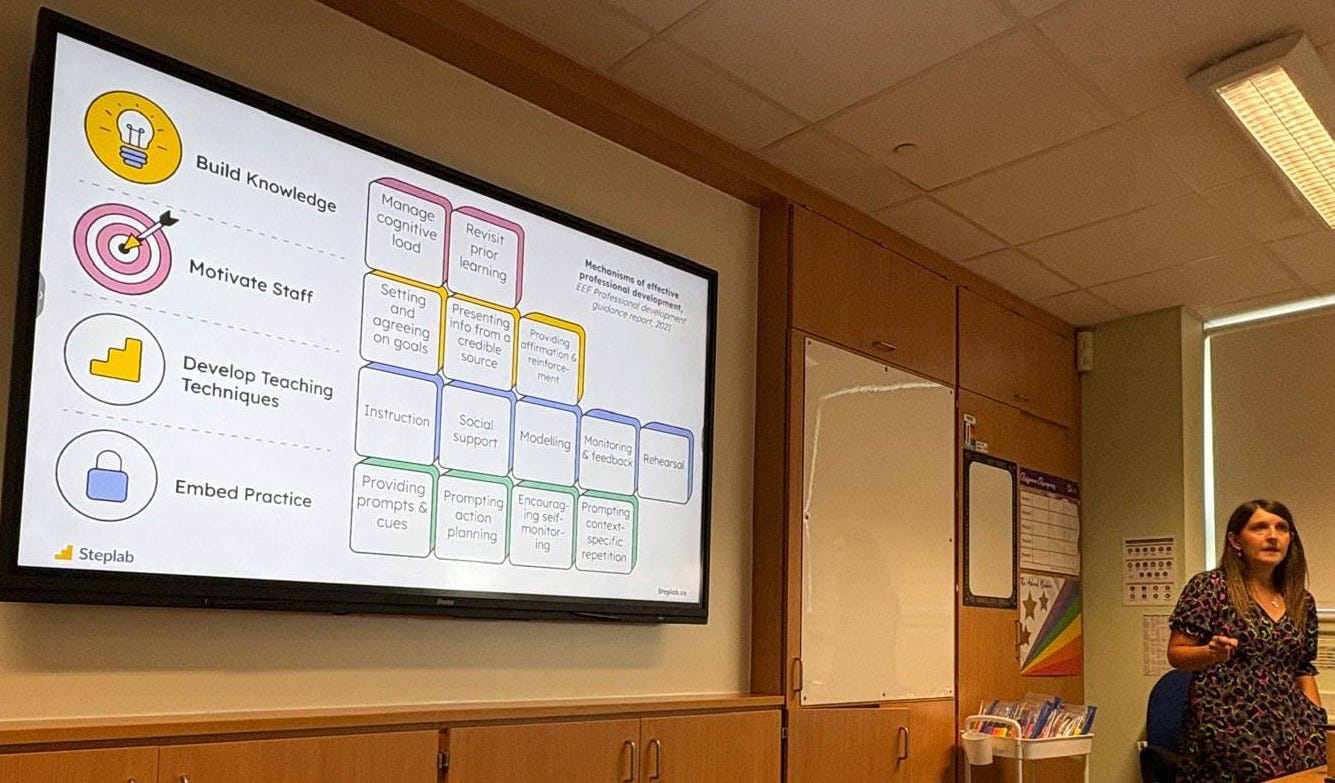
Drawing on her work with StepLab, and the insights gained from working with schools in the UK and internationally, Rachel then explored four of these key mechanisms that make professional development more likely to lead to lasting change:
Managing Cognitive Load
Modelling
Rehearsal
Social Support.
Principle 1: Managing Cognitive Load
The first mechanism was managing cognitive load. The same principle we apply to pupils’ learning also applies to teacher learning. If we overload pupils with too much new information at once, we reduce the likelihood that they will learn it well. The same is true for teachers.
A noisy professional development programme, full of disconnected priorities, initiatives and strategies, is unlikely to lead to sustained change. Teachers may leave with lots of things to think about, but very little that becomes embedded. If everything is the priority, then in practice very little is.
This is why Rachel’s point about focusing on one change at a time is so important. Professional development needs a curriculum. It needs sequencing. It needs revisiting. It needs leaders to decide what matters most now, what can wait, and what successful enactment would actually look like in classrooms.
For senior leaders, this means resisting the temptation to keep adding. For middle leaders, it raises an important question: how does the whole-school professional development priority translate into the subject? A strategy such as checking for understanding, modelling or improving explanation will not look identical in geography, history, science or mathematics. The principle may be shared, but the enactment needs subject thinking.
Principle 2: Modelling
The second mechanism Rachel focused on was modelling. Again, there is a clear parallel with classroom teaching. We would rarely expect pupils to produce high-quality work without showing them what high quality looks like. Yet in professional development, we can sometimes introduce a teaching technique without making its enactment sufficiently visible.
If we want teachers to change practice, they need to see the thing. Not just hear about it. Not just understand the rationale. They need examples of what it looks like in a real classroom: the language a teacher uses, the timing, the positioning, the routines, the way they respond when pupils do not immediately understand, and the small decisions that make the technique work.
This is where live modelling, video examples, peer observation and the growing range of video-based professional development resources can be powerful. Resources such as Carousel Teaching, StepLab’s Great Teaching, Unpacked documentary, and Teach Like a Champion videos can all help make teaching practice more visible. They allow teachers and leaders to move beyond simply discussing a strategy in the abstract and instead look closely at what it actually looks like in the classroom.
Rachel also highlighted how StepLab can support instructional coaching through recording and reviewing classroom video. Over time, this can help schools and trusts build a more contextual bank of examples, drawn from their own classrooms, pupils, curriculum and routines. This matters because modelling can feel more meaningful and achievable when teachers can see what effective practice looks like in a context they recognise.
External examples can help build shared understanding, but internal examples can help bridge the gap between “this is what good teaching looks like somewhere else” and “this is what it can look like here”. Teachers are not watching an idealised version of practice from another context; they are seeing colleagues working with similar pupils, within similar constraints, using shared routines and curriculum materials. This can strengthen credibility and buy-in, while also reinforcing the sense that improvement is possible here, with these pupils, in this context.
Principle 3 - Rehearsal
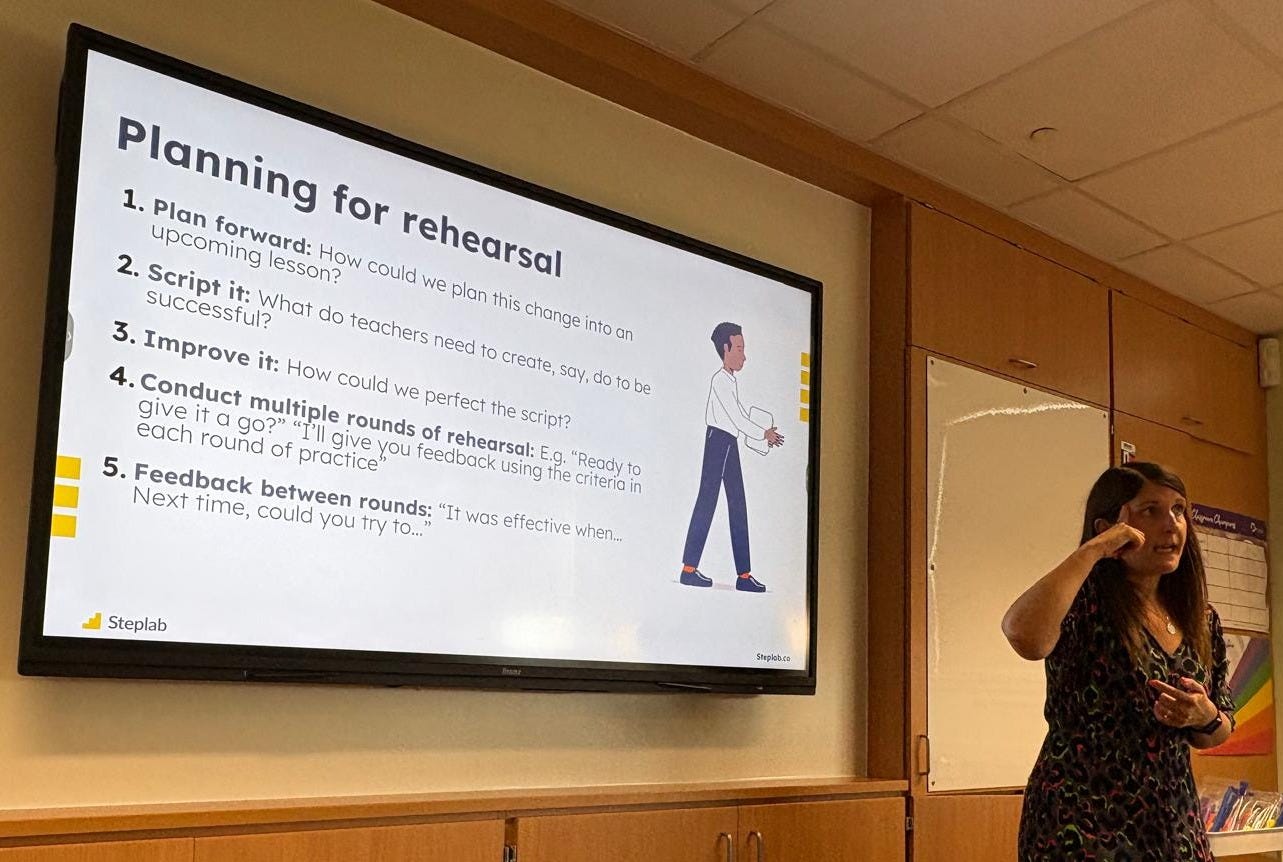
The third mechanism Rachel focused on was rehearsal. This was perhaps the part of the session that challenged me most, not because it was unfamiliar, but because it made me think again about why deliberate practice matters so much if professional development is going to change classroom habits.
Rachel also made an important distinction between role play and rehearsal. Role play can feel artificial because it asks us to pretend to be someone else in a slightly awkward scenario. Rehearsal is different. It is deliberate practice: practising being ourselves, but with greater precision, preparation and intentionality.
This particularly resonated with me because deliberate practice was well embedded in the trust I worked in previously. Weekly deliberate practice was a common feature of professional development, both at whole-school level and within departments. At its best, this created regular opportunities for teachers to practise specific, high-leverage routines before using them with pupils: how to cold call, how to give pupils thinking time, how to narrate a mini-whiteboard routine, how to check responses efficiently, how to transition from pair discussion back to whole-class attention, or how to respond when a pupil gives an incomplete answer.
There are risks, of course. Poorly handled rehearsal can feel performative, patronising or uncomfortable. It can become ‘compliance theatre’ if the culture is wrong. Leadership is key here. Rehearsal needs to be framed and enacted as developmental, not judgemental, and this requires trust, clarity and teacher buy-in. Teachers need to understand why they are practising, what the practice is intended to improve, and how it will help them in the reality of the classroom. I have seen many excellent examples of this in the academies I have worked with, where leaders framed and facilitated rehearsal carefully so that it felt purposeful, supportive and rooted in improving classroom practice.
This is also where shared mental models and collective teacher efficacy become important. Rehearsal is much more likely to feel meaningful when teachers see it as part of getting better together, rather than something being done to them. Done well, it can be hugely powerful. It helps teachers make small but important changes to their practice in a supported space, rather than expecting those changes to happen for the first time in the complexity of the classroom.
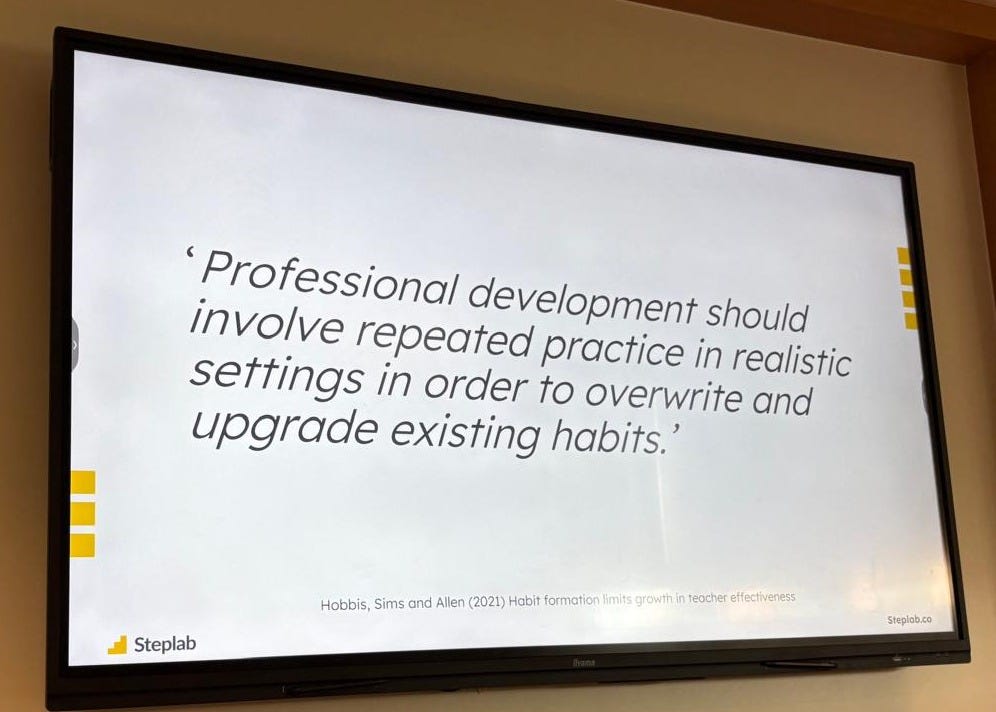
Rachel also picked up on the importance of rehearsal for habit formation. Teaching is cognitively demanding, and when the classroom is busy, we often fall back on existing routines. Some of these may be effective, but others may be less helpful, or may not align with the practice we are trying to develop. If professional development is going to change what teachers do, it has to help teachers interrupt old habits, practise new ones and develop enough fluency for those new habits to become more automatic. Rehearsal gives teachers a supported space to do this before they are expected to enact those techniques in the complexity of the classroom.
Principle 4 - Social Support
The fourth mechanism Rachel focused on was social support, and this is particularly important when thinking about how professional development becomes embedded over time. If we want practice to change, teachers need opportunities to discuss, observe, rehearse, receive feedback and refine what they are doing. Lasting change is difficult when teachers are left to interpret and implement professional development alone. Social support helps move professional development from an individual act of willpower to a collective process of improvement. It gives teachers opportunities to see practice, talk about practice, receive feedback and refine what they are doing.
This does not have to mean heavy-handed observation systems. In fact, it is likely to work best when the culture is developmental rather than judgemental. Peer visits, instructional coaching, shared video, co-planning, subject-specific discussion and focused feedback can all help teachers move from “I understand the idea” to “I can do this more effectively in my classroom”.
This is where tools such as Steplab can support the process, particularly when they are used to strengthen the mechanisms of professional development rather than simply to record activity. StepLab can help leaders and coaches identify patterns, focus feedback and support teachers with precise next steps. Used well, this can make professional development more responsive: not just a generic programme delivered to everyone, but a process shaped by what teachers are trying to improve and what is actually being seen in classrooms.
This is also where I see a link with collective efficacy, which was discussed during the day’s keynote. Improvement is more likely to stick when teachers believe that, together, they can get better at the things that matter. Social support helps build this shared belief by creating opportunities for teachers to see practice, discuss practice, receive feedback and improve practice together.
My Reflections and Key Takeaways from the session:
For teachers
Professional development is not just about knowing more; it is about changing what we habitually do.
Rehearsal is not about pretending to be someone else; it is about practising the moments that matter before they happen.
Seeing examples of practice matters. We need models, not just principles.
Peer support can make improvement more achievable. Done well, it helps make practice visible, shared and open to refinement.
For middle leaders
Translate whole-school professional development into subject-specific practice.
Choose one priority and keep returning to it until it is visible in classrooms.
Use department time to model, rehearse and discuss specific teaching moves.
Create routines where teachers can see practice, discuss practice and refine practice without it feeling judgemental.
For senior leaders
Be careful not to overload the professional development calendar with too many priorities.
Treat professional development as a curriculum: sequenced, revisited, modelled, practised and checked.
Build the conditions for social support: time, trust, clarity and follow-up.
Focus on enactment, not just attendance. The question is not simply “has the session happened?” but “what has changed in classrooms?”