ResearchEd Reflections 2 - Maximising your Questions.
Why effective questioning is about more than asking better questions: it is about thinking, participation and checking what students have really understood.

For my second and third sessions at ResearchEd, I heard Caroline Spencer, Head of Teaching and Learning at the brilliant InnerDrive, talking about Maximising Your Questions, and Claire Badger, Head of Teacher Professional Development, talking about Effective Feedback.
One of the things I really appreciated in both sessions was the way the cognitive science behind the advice was brought out so clearly. I have been thinking a lot recently about the importance of mental models in education, what Jim Heal and Rebekah Berlin in their excellent book Mental Models1 call a “cognitive blueprint that guides our actions”. When we are told to do something without first aligning our mental model, there is a danger that we simply follow the procedure without really understanding the all-important why. These sessions were rooted in evidence-informed theory, which meant that we were not just being given techniques to use in the classroom; we were being helped to build stronger, more accurate models of how the mind works and how students learn. That understanding makes professional development far more meaningful and actionable, and this was certainly the case in both Caroline’s and Claire’s sessions. They embedded the ideas within the principles of cognitive science, including through a number of short experiments, so that we experienced the principles in action rather than simply being told about them. That made the ideas clearer, more memorable and more likely to influence classroom practice, because the strategies were connected to the underlying principles of learning rather than presented as isolated techniques.
Maximising your Questions - Caroline’s session.
I will return to Claire’s session in more detail in a later post, but for now I want to reflect on Caroline’s session and the thinking it prompted.
Checking for understanding in lessons is vital. During our lessons, students are constantly interpreting what we say, what they read, and how ideas connect. Misunderstandings can arise at almost any stage. Caroline demonstrated this brilliantly through the “Sentence Experiment”. A simple sentence shown on the screen had been interpreted in numerous different ways by delegates in the room, depending on where we placed intonation as we read it. It was a powerful reminder of how easily meaning can shift, and therefore why frequent checks for understanding matter so much.
Yet this still does not always happen, or happen enough. There is also the danger of assuming that diligent students, those who appear hardworking, quiet, focused and compliant, are understanding. But silent engagement in the work is not the same as secure understanding. If we do not check, students may not have learned anything or they may have learned something, but learned it incorrectly. Once a misconception has taken root, it can be much harder to unlearn. This is why checking for understanding needs to involve as many students as possible, not just the loudest or quickest to respond.
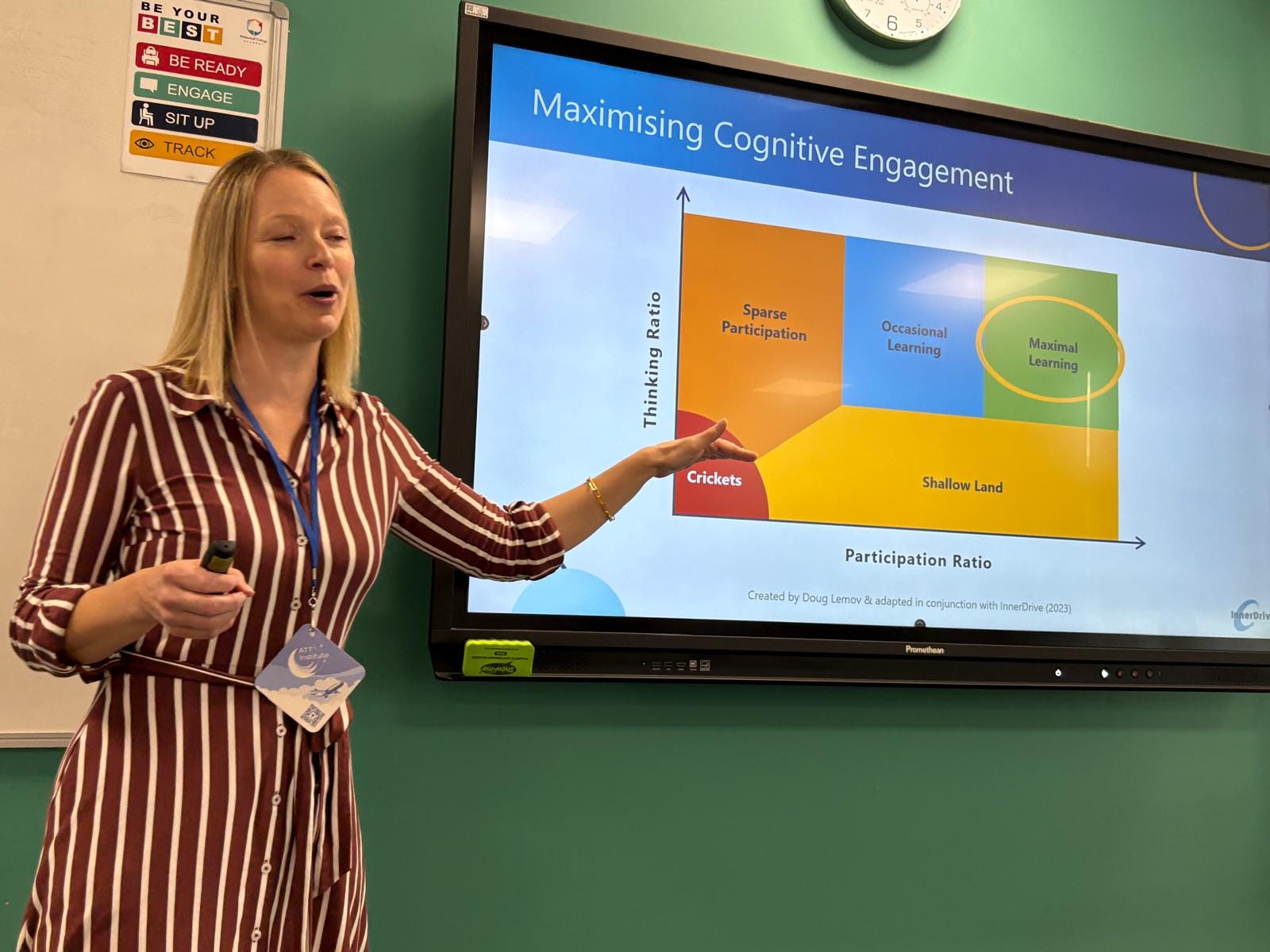
Bradley Busch from InnerDrive writes about this through the idea of thinking and participation ratios. Maximal learning takes place when we can get as many students as possible to think hard and participate. Maximising the thinking ratio depends, in part, on the quality of the questions we ask. This is where intellectual preparation matters. We need to craft questions that are challenging, purposeful and designed to reveal misunderstandings. The importance of planning questions before the lesson is clear. Cognitive load is high for any teacher in the middle of a lesson, so having carefully planned questions enables us to be more adaptive, not less. Because we have done some of the second-order thinking before the lesson, we are better able to listen carefully to the answers students give and respond appropriately.
Caroline also reminded us that retrieval questions should not always be too easy. If questions are too simple, they can create the illusion of learning rather than the reality of learning. This links to the idea of desirable difficulties: that learning is strengthened when students experience appropriate challenge, uncertainty and productive struggle. The best learning does not always feel easy. Some discomfort can be a sign that students are having to think hard. There is a good post by Inner Drive to follow up on these ideas here: Why ignorance and discomfort may belong in the learning process | InnerDrive
So there is a lot to think about in relation to asking good questions and maximising the thinking ratio. But if we return to those diligent but quiet students, another issue emerges. Where the thinking ratio is high but the participation ratio is low, we get sparse participation. The loudest, quickest or most confident students dominate, while quieter students remain unheard. They may well have been thinking, but we do not know whether they have understood. Worse, they may have misunderstood, and we may not have noticed.
This is where the third part of Caroline’s session was so useful: thinking not just about the questions we ask, but about how we gather answers from students. The method matters. If we want to maximise the participation ratio, we need to think carefully about the checks for understanding we choose, whether that is mini-whiteboards, cold calling, think-pair-share, whole-class response systems or other approaches.
Cold calling is particularly important for active participation. Caroline discussed research suggesting that where little cold calling is used, participation patterns are unlikely to change very much. The same students continue to dominate. However, where cold calling is used consistently and carefully over time, participation can increase because students become more used to contributing. The fear of failure reduces when participation becomes a normal part of the classroom culture. Confidence and competence can grow through practice.
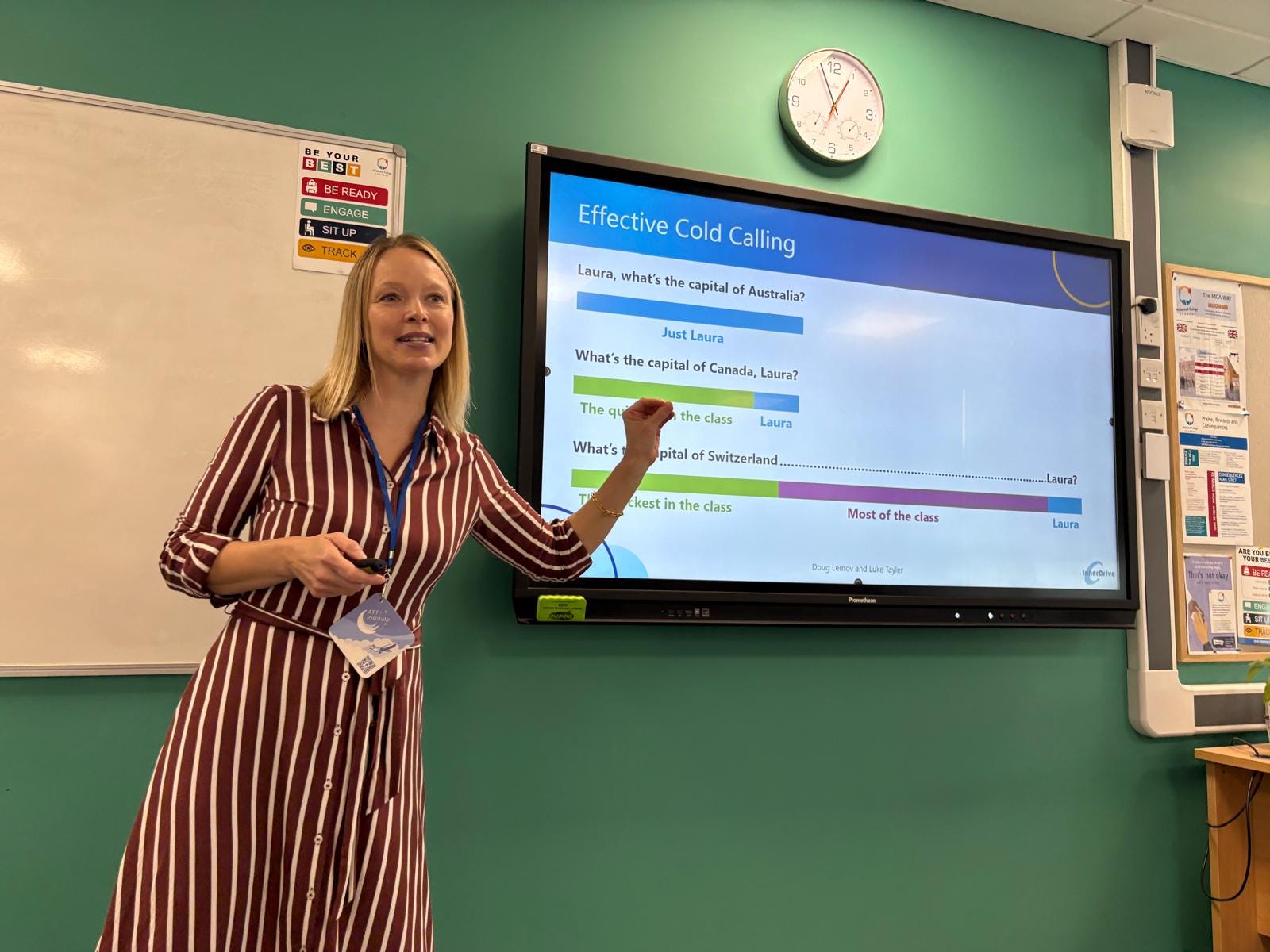
However, the way cold calling is done matters enormously. Caroline talked about two types of cold calling: compliant, or unconditional, cold calling, and collaborative cold calling. Where there is a rigid question-answer format, students may feel obliged to comply. This can increase anxiety and lead to shallow discussion. By contrast, collaborative cold calling feels more like an invitation to join the thinking. Students are more likely to offer authentic responses, feel that their contributions are valued, and take part in richer classroom dialogue.
The next question, then, is how we develop this more collaborative style of cold calling (this is a great post to follow this up further). Building the right classroom culture is crucial. Students need to understand why cold calling is being used. They need to know that it is not about catching them out, but about helping everyone think, participate and learn. Mistakes need to be treated as opportunities, not failures.
Once students experience psychological safety, they are more likely to participate. To support this culture, we can use strategies such as warm, informed cold calling: using active observation, circulating, listening in and checking work to choose pupils in a way that builds participation rather than heightens threat. Over time, students can become more willing to have a go because the process does not feel so high-stakes.
Caroline also reminded us of the importance of wait time. If I ask, “Rob, what do we mean by erosion?”, then Rob is probably listening very intently, but many others may have already switched off with a sigh of relief. By contrast, if I ask, “What do we mean by erosion?” — pause — “Rob?”, then everyone has had to think because anyone could be asked. That small change can make a significant difference. Building in wait time increases both the quality and quantity of answers.
Think-pair-share can also be particularly useful, especially for more nervous students. It is less threatening because pupils have the chance to rehearse and validate their thinking with a partner before sharing more publicly. Used well, it can support both thinking and participation.
The big takeaway for me was that questioning is not just about asking more questions, or even asking better questions. It is about understanding how questions shape thinking, participation, confidence and classroom culture. If we want to check understanding properly, we need to design questions that make students think hard, and then use participation structures that allow us to hear from as many students as possible. Otherwise, we risk mistaking silence for understanding, diligence for secure learning, and participation from a few for learning across the room.
So what are my key takeaways, and what are the implications for my practice and my work with others?
To summarise I think there are 5 key things I took from this session:
Professional development is more powerful when it builds mental models, not just techniques. Caroline and Claire’s sessions worked because the strategies were connected to cognitive science, helping teachers understand the why behind the practice.
Checking for understanding matters because meaning is fragile. Students can interpret explanations, texts and questions in different ways, so teachers need frequent checks to identify misunderstanding before it becomes embedded.
Silent diligence is not the same as secure understanding. Quiet, hardworking students may appear engaged, but without deliberate checks we risk mistaking compliance or effort for learning.
Good questioning depends on intellectual preparation. Planning questions in advance helps teachers ask more purposeful questions, reveal misconceptions and respond more adaptively during the lesson.
Participation structures matter as much as the questions themselves. Cold calling, wait time, mini-whiteboards and think-pair-share can help increase participation, but they need to be used in ways that build psychological safety rather than anxiety.
Reflections:
A lot of what I heard in the session was not completely new to me, but it was still incredibly important. In fact, that is part of the point. We often need to hear important ideas more than once. The more we return to them, think about them and connect them to our own practice, the more they become embedded and automatic. Each time we revisit them, we may also notice something different. This time, I found myself thinking less about questioning simply in terms of my own classroom practice, and more about how I might help others understand and use these ideas well.
For me, as someone who has worked a lot with supporting staff to improve their practice, I was particularly struck by the power of those brief but essential and effective references to the underpinning cognitive science that Caroline made. The quick experiments, links to research and explanations of why particular strategies work were not add-ons. They were what helped make the strategies meaningful. They provided the clarity behind the practice, the why, which means the implementation is more likely to be thoughtful, purposeful and sustained. In any work I do with teachers, this is another reminder of the importance of aligning mental models if we want professional development to have real impact. This also connects strongly with Dr Haili Hughes’ recent post on teacher decision-making and mental models.
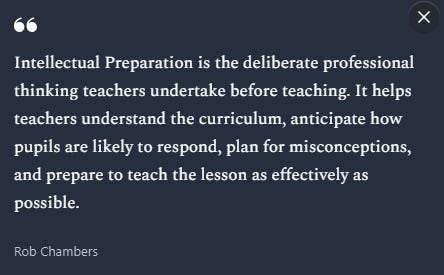
It also reminded me again of the importance of intellectual preparation: not just understanding the why, but also thinking carefully about the how. This is not simply about scripting questions in advance. It is about understanding what makes a good question, when that question needs to be asked, and where the hinge points in the lesson are. At what point do I need to know whether all students have understood before I move on? What question will best reveal whether they have understood? What misconception am I trying to uncover? How will I gather responses from enough students to know whether the class is ready to continue?
This links directly to the three posts I wrote last week on intellectual preparation, and has given me further food for thought about the granular aspects involved in good IP. Maximising questions is not just about the wording of the question itself. It is about maximising the thinking ratio through the quality and challenge of the questions we ask, and maximising the participation ratio through the way we gather and respond to students’ answers. In that sense, questioning is not a standalone technique. It sits right at the heart of responsive teaching, adaptive practice and effective intellectual preparation.
Reference:
1 Heal, J. and Berlin, R. (2025) Mental Models: How understanding the mind can transform the way you work and learn. London: John Catt Educational.