ResearchEd Reflections: Developing Resilience
Reflections on Bradley Busch’s researchED Yorkshire session and how we can create the conditions to develop resilient students.

Bradley Busch’s session on Developing Resilience was a useful reminder that resilience is one of those ideas in education that can easily become vague or over-simplified. We often talk about wanting pupils to be more resilient, but the more important question is: what conditions help resilience to develop?
In his talk, Brad focused on three examples of how we can help develop resilience.
Environment
Response to Setbacks - Process Focused
Groups Norms.
1. Environment
One of Brad’s central points was that individual levels of resilience are not always strong predictors of future behaviour. Pupils may have good intentions, but converting good intentions into changed behaviour is difficult. A better predictor of future behaviour is often the environment.
This matters because behaviour is shaped by context. If we want pupils to persist, take intellectual risks, and respond well to difficulty, then we need to think carefully about the classroom conditions we create.
Brad argued that resilience is not taught in isolation. It develops when pupils experience both high challenge and high support. Challenge without support can feel overwhelming. Support without challenge can lower the level of expectation. But when pupils are given demanding work, alongside the belief, guidance and scaffolding needed to meet that demand, resilience has somewhere to grow.
This links strongly with Mary Myatt’s argument in her book The Ambitious Years and the importance of keeping intellectual challenge high at Key Stage 3. If KS3 is where intellectual life begins, then it should also be where pupils learn that difficulty is normal, thinking hard is expected, and support is available when they encounter struggle.
Brad also connected this to the Pygmalion effect: the idea that expectations can become self-fulfilling. In schools, teacher expectations can influence pupil outcomes because they shape how pupils are taught, questioned, supported and responded to. When teachers genuinely believe pupils are capable of succeeding, and communicate that belief through their actions, pupils may be more likely to meet those expectations.
This is not about vague positivity or simply telling pupils they can do well. It is about how high expectations are enacted: through the level of challenge pupils are given, the quality of questioning, the feedback they receive, the opportunities they have to improve, and the seriousness with which their thinking is treated.
In this sense, the Pygmalion effect links closely to resilience. If pupils repeatedly experience classrooms where adults expect them to think hard, persist, improve and succeed, then resilient behaviour becomes more likely. The expectation is not just stated; it is built into the environment.
2. Responding to Setbacks: Comfort or Process?
Brad then explored how the way teachers respond when pupils experience setbacks can influence whether pupils see difficulty as something to learn from, or as evidence that they cannot succeed.
The example Brad used was a pupil achieving 65% in a maths exam. The result itself is the same, but the teacher’s interpretation of that result can lead to very different responses (see slide below).
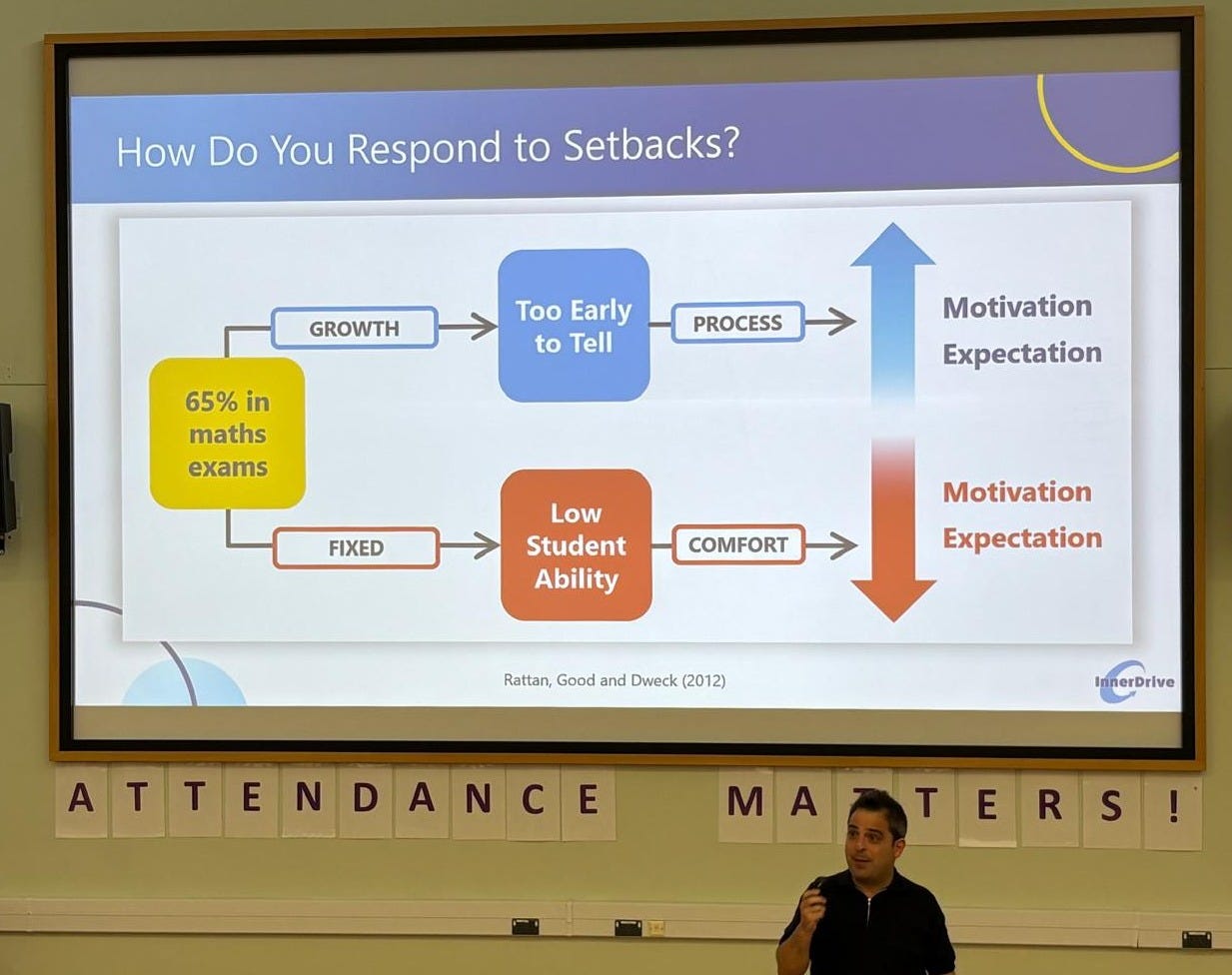
If the teacher views the result through a growth lens, they may decide it is too early to make a judgement about the pupil’s ability. Instead, they focus on the process: what did the pupil understand, where were the gaps, what strategies might help, and what feedback, practice or support is needed next? This kind of response communicates that improvement is possible and that the setback gives useful information about what to do next.
By contrast, if the teacher views the result through a fixed lens, they may interpret it as evidence of low ability. Their response may then become comfort-focused: “Don’t worry, you tried your best,” or “Maths isn’t for everyone.” That response may be well intentioned, and may come from a place of care, but it can unintentionally communicate lower expectations. The pupil may hear: “Perhaps I am not really capable of getting better at this.”
This is where the link to resilience becomes important. Pupils do need warmth, reassurance and encouragement, but reassurance alone is not enough. If our response to struggle stops at comfort, we may soften the immediate disappointment without helping pupils understand how to improve.
A process-focused response keeps belief, improvement and growth mindset connected. It communicates that this has not gone as well as we wanted yet, but there are things we can learn from it, and there are actions we can take. The setback is not treated as proof of fixed ability, but as useful information about the next stage of learning.
In that sense, resilience is supported not by pretending setbacks do not matter, but by helping pupils see setbacks as something they can learn from and act on.
3. Making Effort the Norm: The Social Side of Resilience
Finally, Brad explored the importance of group norms and social dynamics in shaping resilience. Pupils often do not make decisions in isolation. They are influenced by the behaviour, expectations and cues of those around them.
This is where the Bandwagon effect becomes important. If a behaviour appears to be normal within a group, pupils are more likely to follow it. Over time, what the group does can start to feel like what the group values. This matters in classrooms because behaviours such as effort, participation, persistence and careful listening can either become socially valued, or quietly undermined by the wider peer culture.
Brad’s point was that we can use this understanding deliberately. If pupils have a strong need to belong, then part of our work is to make the right behaviours feel normal and valued. This means publicly reinforcing the behaviours we want to see: narrating when pupils are working hard, praising thoughtful contributions, highlighting when the majority are ready, and making visible the fact that many pupils are engaging positively.
For example, with something like cold call, the framing matters. If pupils hear that most people are listening carefully, tracking the discussion, preparing an answer and willing to contribute, then participation starts to feel like the norm. Public praise and positive narration can help build that social norm over time.
This also means being deliberate about what we make visible in the classroom. If we repeatedly draw public attention to poor behaviour, we may unintentionally make it feel more common or more powerful than it really is. Often, the better approach is to publicly reinforce the positive majority while dealing with poor behaviour individually and calmly. For example, saying “90% of you are now doing exactly what I asked” makes the desired behaviour visible and frames it as the norm, without giving disproportionate attention to the small number of pupils who are not yet meeting expectations.
Brad emphasised how this leads to resilience as pupils are more likely to persist when effort and improvement carry social value. If the classroom norm is that we think hard, make mistakes, improve answers, respond to feedback and keep going, then resilient behaviours are not just individual acts of willpower. They become part of the culture of the room.
Reflections and key takeaways:
My key reflection from the session was the level of influence we can have on pupils’ resilience through our own actions and the classroom conditions we create.
Resilience can sometimes be too quickly framed as something fixed: a quality a pupil either has or lacks. Brad’s talk pushed against this. It reinforced the idea that we can actively support the development of resilient students through the expectations we communicate, the way we respond to setbacks, and the social norms we help to build in our classrooms.
It reminded me that we should not underestimate how much resilience is shaped by pupils’ everyday classroom experiences, and therefore how deliberately we need to think about the conditions we create.
In that sense, developing resilience is not separate from curriculum, teaching, feedback or classroom culture. It is woven through them.
Key Takeaways for Classroom Practice
1. Build resilience through high challenge and high support
Pupils need opportunities to think hard, struggle productively and experience challenge, including desirable difficulties, but within an environment where support, guidance and belief are made visible.
2. Make expectations visible through action
High expectations are not just communicated through what we say. They are communicated through the curriculum we offer, the questions we ask, the feedback we provide, and the seriousness with which we treat pupils’ work.
3. Respond to setbacks with a clear route forward
Warmth and reassurance are important, but they need to be paired with a process for moving forward. Pupils need help to see what went wrong, what they can learn, and what comes next, while keeping a growth mindset lens.
4. Actively develop classroom norms
We can deliberately reinforce effort, participation, improvement and persistence so that these behaviours become part of the classroom culture.
5. Reinforce the positive majority, not the negative minority
Publicly reinforcing the positive majority, rather than focusing on the negative minority, can help create a stronger social norm around effort and engagement. It avoids making poor behaviour feel more common than it is. Poor behaviour still needs to be addressed, but calmly and individually where possible.
Finding out more:
If you have not come across InnerDrive’s resources before, I would strongly recommend having a look at their website, particularly their Education Resources section, which contains a wealth of free materials.
They have also published some excellent books to support professional development, including the Teacher CPD Academy book series, which focuses on different applications of cognitive science to teaching and learning.
Alongside this, InnerDrive offer in-person training for both staff and students, as well as their online platform, the Teacher CPD Academy.