From Feedback Given to Feedback Used
Reflections on Kate Jones’ researchEd Yorkshire session, "Making Feedback Matter" and why the value of feedback lies not in how much we give, but in what students do with it.

Feedback has to change something
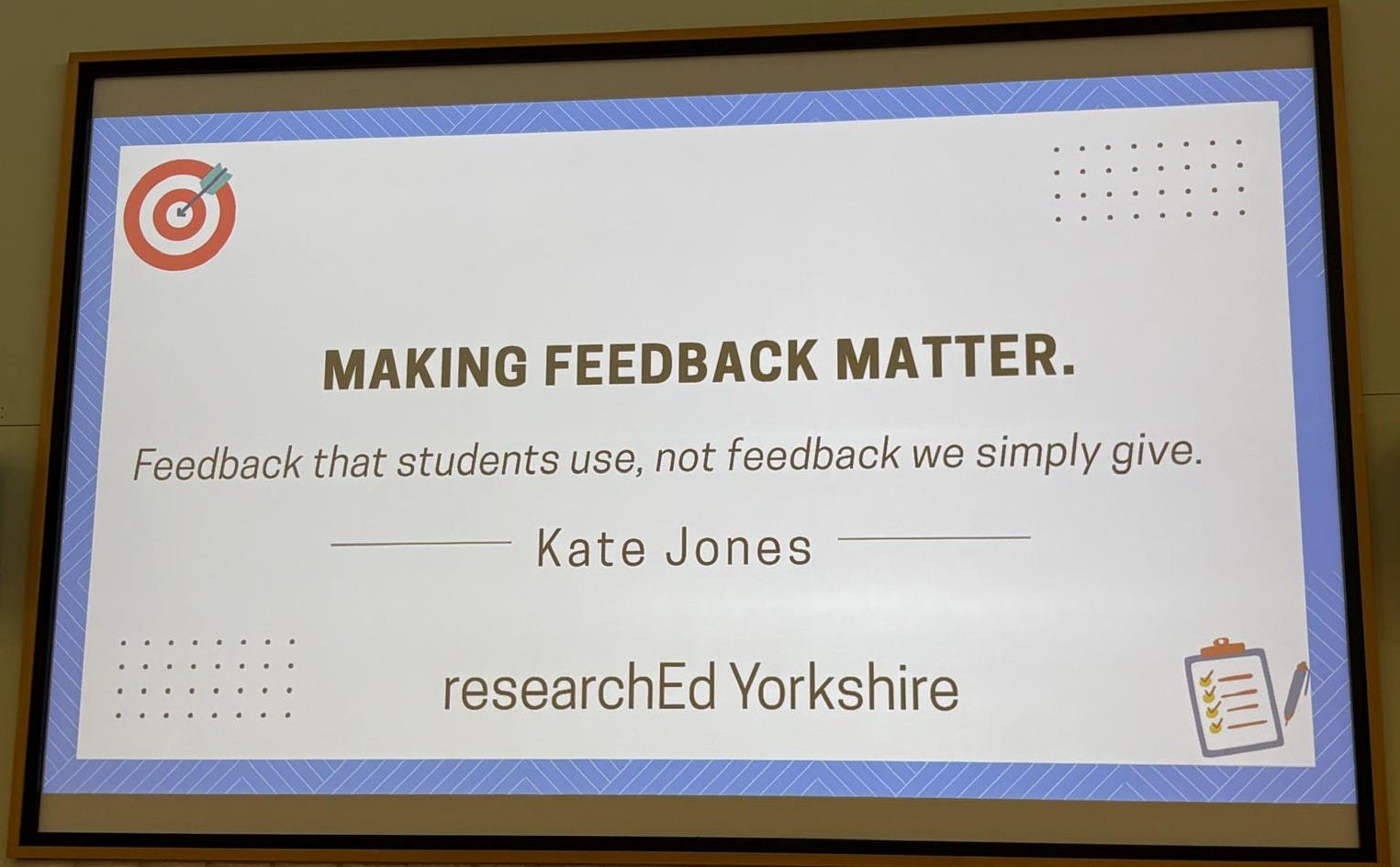
Kate Jones’ session on Making Feedback Matter at researchED Yorkshire was an important reminder that feedback is not valuable simply because it exists. Drawing on Dylan Wiliam’s [1] point that the main purpose of feedback is to improve the student, not simply the work, Kate encouraged us to think carefully about that feedback is actually doing. If it does not change something for the learner, their understanding, their thinking, their confidence, their strategy or their next action then we have to ask whether it has been worth the time invested.
This links closely to Kate’s excellent Evidence Based Education post, Poor Proxies for Effective Feedback, which explores feedback practices that may be well-intentioned but do not necessarily improve learning. This is an important challenge. We can sometimes mistake the presence of feedback, such as comments, codes, stickers, coloured pens or written responses, for evidence that feedback has had an impact. But the real question is not whether feedback has been given. The real question is whether learning has moved forward.
That can be an uncomfortable but necessary question when we reflect on our own practice. It asks us to look honestly at whether our feedback, however carefully given, has actually changed what students understand, think or do next. Kate’s session certainly made me think back to earlier points in my career when I would spend hours writing detailed comments on GCSE and A level work. Often, I was writing similar things repeatedly across a set of books or scripts. At the time, I think I believed that the more feedback I gave, the more helpful it would be for students. But looking back, I am not sure it always led to the improvement I hoped for. The issue was not the effort. The issue was whether the feedback was actually usable by the student. In some cases, I suspect students may also have been drowning in feedback, something I return to later in this reflection.
Kate framed feedback as serving several possible purposes: acknowledgement, motivation and improvement. Feedback can be positive or negative, verbal or written, immediate or delayed. But whichever form it takes, it needs to be judged by its impact on learning.
She set out three key principles. Feedback should be:
Evidence-informed
Workload-friendly
Designed to move learning forward
That workload point is crucial. Feedback cannot become something that teachers drown in either. If feedback systems depend on teachers spending unsustainable hours writing comments that students may not read, understand or act upon, then the system is flawed. Again, on reflection, in my formative years as a teacher, I think many hours were spent in exactly this way.
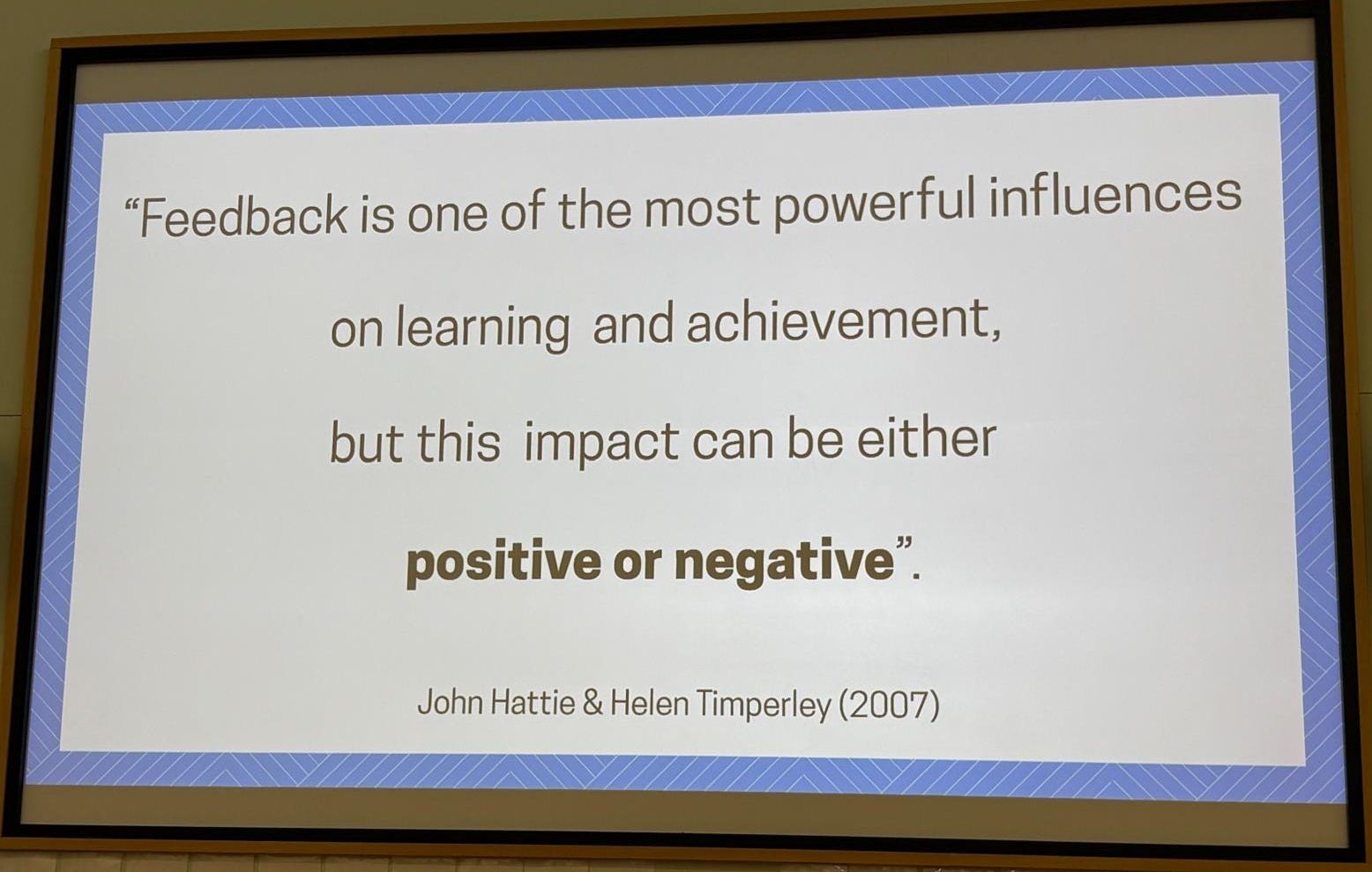
Kate also explored the question of whether feedback should be immediate or delayed. In reality, both have value. Immediate feedback can be powerful when misconceptions need addressing there and then. Delayed feedback can also be useful, particularly when it supports retrieval, reflection and longer-term retention. But timing is not the only thing that matters. We also need to think carefully about how feedback is delivered. If students focus only on a grade, score or mark, they may pay less attention to the feedback itself and what they need to do next. The important thing is not to assume that one form of feedback is always better, but to be clear about its purpose and how it will help students move their learning forward.
Making feedback usable
A key reminder that Kate gave us was that feedback happens in every lesson. Much of it is not visible. It happens through questioning, circulation, prompts, modelling, rephrasing, correction, live discussion and the way teachers respond to what students are doing in the moment. Verbal feedback matters, but because it is transient, we sometimes need to think carefully about how students will return to it and use it.
This linked to Kate’s discussion of the conditions for effective feedback. For feedback to matter, it needs to be:
Understandable
Helpful
Actionable
That sounds simple, but it is often where feedback fails. Students may receive feedback but not really understand what it means. They may understand it but not know what to do next. Or they may act on it in a superficial way that does not transfer beyond that particular piece of work.
I liked Kate’s reminder, drawing on a point from Stone and Heen’s 2014 book[2], that we all “swim in an ocean of feedback”. That means we have to prioritise. Feedback itself does not empower students. Usable feedback does. Feedback does not improve learning simply by existing; what matters is what students do with it.
One practical strategy Kate shared was Record and Respond. After verbal feedback, students summarise the key point on a sticky note. The value is not the sticky note itself, but the way it keeps the feedback alive. It can be moved forward, revisited and used as the student continues working. Crucially, though, the evidence of progress is not the sticky note. The evidence is the improvement in the work.
That distinction is important. Returning to the idea of poor proxies for effective feedback, we should not confuse the recording of feedback with the impact of feedback. The impact is seen in the student’s book, answer, explanation, diagram, graph, essay or subsequent attempt.
Another useful technique mentioned was dot feedback. Rather than correcting everything for the student, the teacher identifies with a dot in the margin that there is an error and the student has to find and fix it. This can be adapted depending on the student and the nature of the task. For some students, a simple dot in the margin may be enough. Others may need more precise guidance, such as highlighting the specific sentence, word, calculation or part of a diagram that needs attention. The principle is that feedback should still make students think, but it also needs to give them enough support to act on it successfully.
Kate also discussed the role of praise within feedback. We are all familiar with generic praise: “Excellent”, “Well done”, “Great work.” There is nothing wrong with encouragement, but vague praise does not always help students understand what they did well or what they should repeat. Likewise, if praise is overused, it can lose value. Praise is often more powerful when it is specific, sincere and earned.
Kate referenced Doug Lemov’s idea of precise praise [3] here. Rather than simply saying “excellent answer”, we might say: “That was strong because you backed up your judgement with a clear place-specific example.” That helps the student know what to repeat. It can also help frame critical feedback within a positive classroom culture, so that students are more likely to experience feedback as purposeful, supportive and useful, rather than as criticism for its own sake.
Written feedback, of course, still has a place. The challenge is time and volume. Kate talked about selective feedback, where the teacher focuses on one particular element rather than trying to comment on everything. I liked the idea of using colours to direct attention: for example, a yellow box around the part to improve and a blue box around the strongest part, with students then reflecting on why. This helps feedback become focused rather than overwhelming.
Whole-class feedback was another key theme. Instead of writing the same comment thirty times, the teacher can identify common strengths, common errors and then model how to improve. This feels particularly powerful in geography, where we often need to show students what a better explanation, judgement, graph, map annotation or use of evidence looks like.
Responsive Feedback
One form of feedback that I have seen used well in schools is active observation during independent work. While students are working, the teacher circulates, notices patterns, identifies misconceptions and selects strong examples. Where a common error or misconception is emerging, it can be worth pausing the class there and then, rather than waiting until after the lesson to discover the same issue in books. A short re-explanation, additional model or correction at that point can prevent students practising the error further. It also gives the teacher useful information about who might benefit from being brought into the discussion through cold call, whose work could be used as an exemplar, and where the class may need further clarification. This is feedback as responsive teaching: noticing what is happening, acting on it, and helping students move forward while they are still engaged in the task.
Kate’s point about Do Now feedback also resonated. I have sat in classrooms where answers are revealed all at once and students simply tick or cross. But the feedback moment is where much of the learning can happen. Revealing answers one at a time, pausing to unpack errors and discussing why an answer is correct or incorrect is far more valuable. As Kate said, if this takes too long, reduce the number of questions rather than rushing the feedback.
I also appreciated the reminder of Adam Boxer’s Tick Trick [4]. When reviewing an answer, the teacher allocates ticks for specific features they want students to have included. Students complete the answer first; the teacher then goes through the answer step by step, identifying what earns a tick. Students give themselves ticks and may then swap with a partner to check that the ticking is accurate. The point is that students look carefully at the components of their answer, not just whether they got the final answer right.
In geography, this could work well for graph construction: a tick for labelled axes, a tick for an accurate scale, a tick for bars drawn with a ruler, a tick for a clear title, a tick for correct units and a tick for using the key correctly. It could also support geographical calculations. For example, when calculating a mean, students might earn a tick for adding the values correctly, a tick for dividing by the correct number, and a tick for giving the answer with appropriate units.
However it can be useful not only for procedural accuracy, such as constructing a graph or completing a calculation, but also for making explicit the components of a stronger geographical exam response.
For example, in an explanation of landform development, ticks could be awarded for defining the landform, outlining the relevant geomorphic processes, using precise key terminology, sequencing the stages of formation clearly, and explaining how one stage leads to the next. This matters because students often name a process, such as hydraulic action or abrasion, without explaining how that process works or how it contributes to the development of the landform. The Tick Trick can therefore help make the components of a successful geographical explanation more visible, rather than focusing only on the final mark.
Peer critique and collective improvement
Kate also referred to Ron Berger’s Gallery Critique [5] as a form of peer feedback. This can be powerful when students receive feedback from a range of peers, but it only works well when the context and culture are right. Berger’s mantra, ‘kind, specific and helpful’, really matters. Students need to be taught how to critique work properly. Sentence stems can help, but so can modelling what useful critique actually sounds like.
There is an interesting link here to collective student efficacy, which I reflected on in response to the keynote. Peer critique is most powerful when students believe that, together, they can help one another improve. It is not just about students commenting on each other’s work; it is about creating a culture where improvement is shared, visible and expected. Without that culture, peer feedback can easily become superficial, overly polite, too vague, or, at worst, uncomfortable for students. With the right conditions, however, it can help students see improvement as something collective rather than individual.
Exam wrappers and returning to feedback
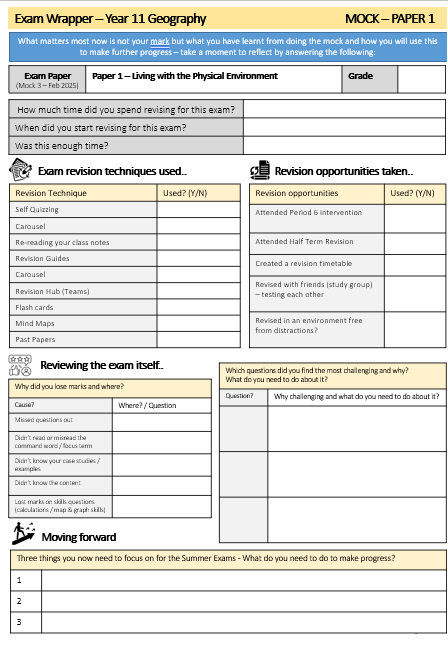
Finally, Kate talked about exam wrappers, often associated with the work of Marsha Lovett at Carnegie Mellon University [6] . Originally developed in higher education to support students’ metacognition, exam wrappers are structured reflection tools used after an assessment to help students think beyond the mark or grade. Rather than simply asking “What did I get?”, they encourage students to reflect on how they prepared, which questions they found difficult, where marks were lost, what misconceptions were revealed, and what they need to do differently next time.
This was something I had already explored and trialled after reading Kate’s feedback book. I found them useful because they help shift assessment feedback from a focus on performance to a focus on learning and future action. They can also support students to engage more deliberately with the feedback they have received, particularly when the wrapper is returned to over time.
For example, an exam wrapper completed after Mock 1 in Year 11 could be revisited five or six weeks before Mock 2, again when revision begins, and again just before the exam. Returning to it at these points helps students use the feedback at the moment it is most likely to shape their next actions. Several weeks before the next mock, it can inform revision planning. At the start of revision, it can remind students of the topics, strategies or question types that need attention. Just before the exam, it can act as a final prompt about avoidable errors, timing, command words or exam technique. In this way, the feedback does not sit as a one-off activity. It becomes something students return to, use and act upon.
Making feedback matter
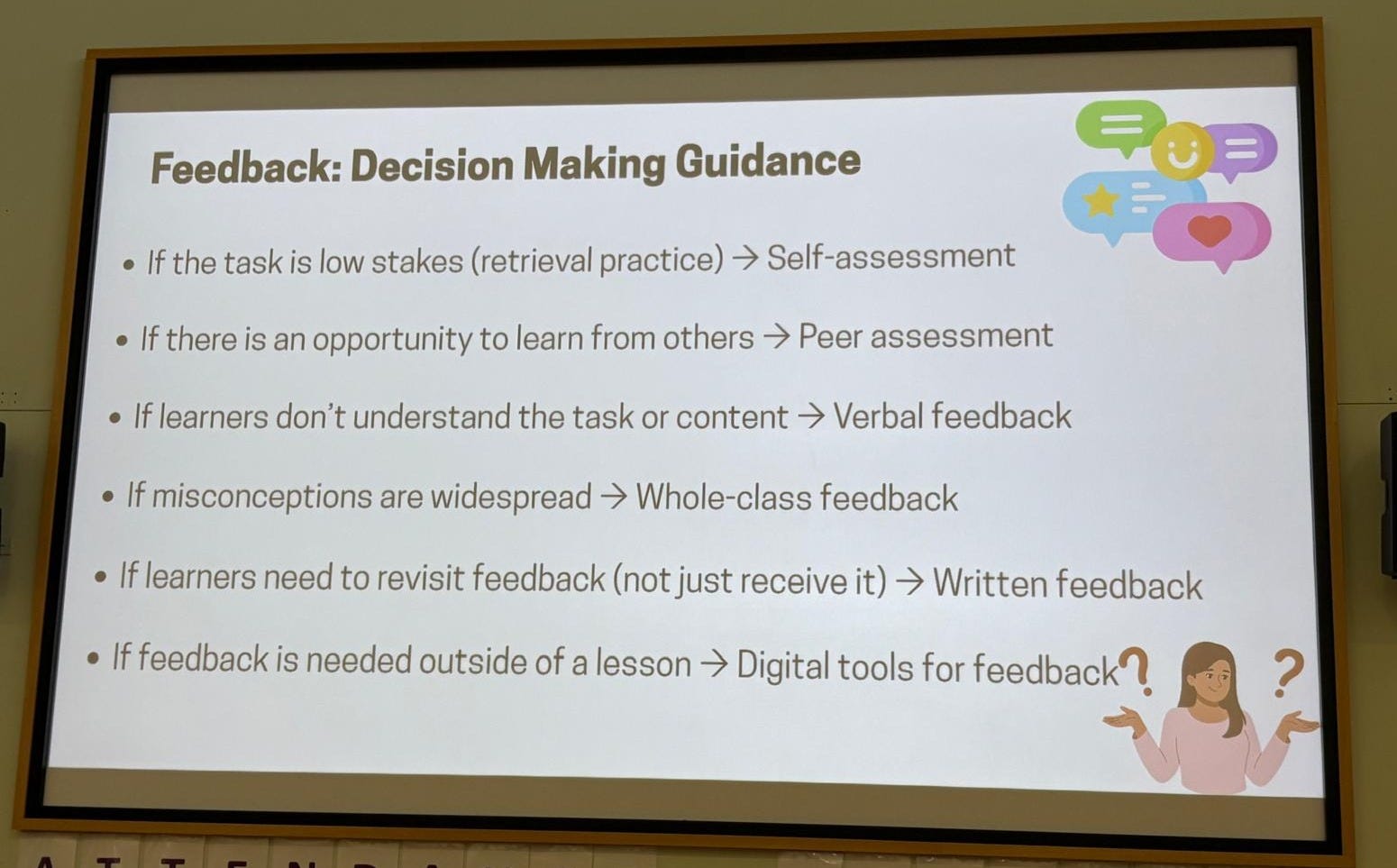
One of Kate’s slides captured this decision-making particularly clearly. The form of feedback matters less than the purpose it is serving: low-stakes retrieval may lend itself to self-assessment; opportunities to learn from others may support peer assessment; widespread misconceptions may require whole-class feedback; and some feedback may need to be written or digital if students need to revisit it later.
Kate ended her talk by reinforcing three key messages:
Check that learners understand the feedback.
Ensure students act on the feedback.
Make sure students are not drowning in feedback.
Once again, it was that third point that made me reflect most on my own formative practice. Feedback should not become a performance of teacher effort. It should be a mechanism for student improvement. Making feedback matter means making it purposeful, proportionate and usable. It means thinking less about how much feedback we give, and more about whether students can understand it, act on it and carry it forward into better thinking and better work.
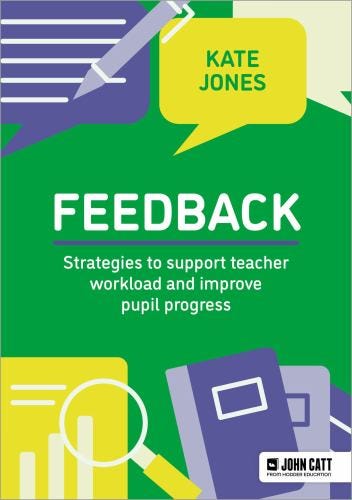
For those wanting to follow this up, Kate Jones’ Feedback: Strategies to Support Teacher Workload and Improve Pupil Progress [7] is the obvious next read, alongside her wider work on retrieval practice and research-informed classroom routines. I can highly recommend it. My copy is well-thumbed, covered in sticky notes, and was something I referred to regularly during my time as a trust subject lead.
Above all, Kate’s session was a reminder that feedback only really matters when it becomes usable by students. The challenge is not simply to give more feedback, but to make sure that it is understood, acted upon, and carried forward into better thinking and better work.
[1] Wiliam, D. (2011). Embedded formative assessment. Solution Tree Press.
[2]Stone, D. and Heen, S. (2014) Thanks for the Feedback: The Science and Art of Receiving Feedback Well. New York: Viking.
[3] How Positive Framing and Precise Praise Fit Together | Teach Like a Champion
[4] Feedback: hitting home – A Chemical Orthodoxy (Adam Boxer)
[5] Berger, R. (2003) An Ethic of Excellence: Building a Culture of Craftsmanship with Students. Portsmouth, NH: Heinemann.
[6] Lovett, M. C. (2013) ‘Make exams worth more than the grade: Using exam wrappers to promote metacognition’, in Kaplan, M., Silver, N., LaVaque-Manty, D. and Meizlish, D. (eds.) Using Reflection and Metacognition to Improve Student Learning: Across the Disciplines, Across the Academy. Sterling, VA: Stylus, pp. 18–52.
[7] Jones, K. (2024) Feedback: Strategies to Support Teacher Workload and Improve Pupil Progress. London: Hachette Learning.