Making Thinking Visible
Reflections on checking for understanding, intellectual preparation and David Goodwin’s rEDYorkshire 2026 talk “What Are They Thinking?”

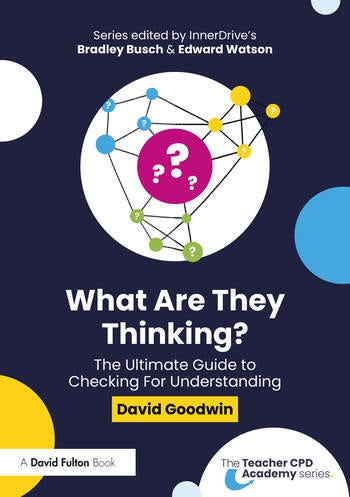
It is always great hearing David Goodwin speak, and I am really looking forward to his new book, which has the same title as his talk, ‘What Are They Thinking?’, which is due out September 23rd.
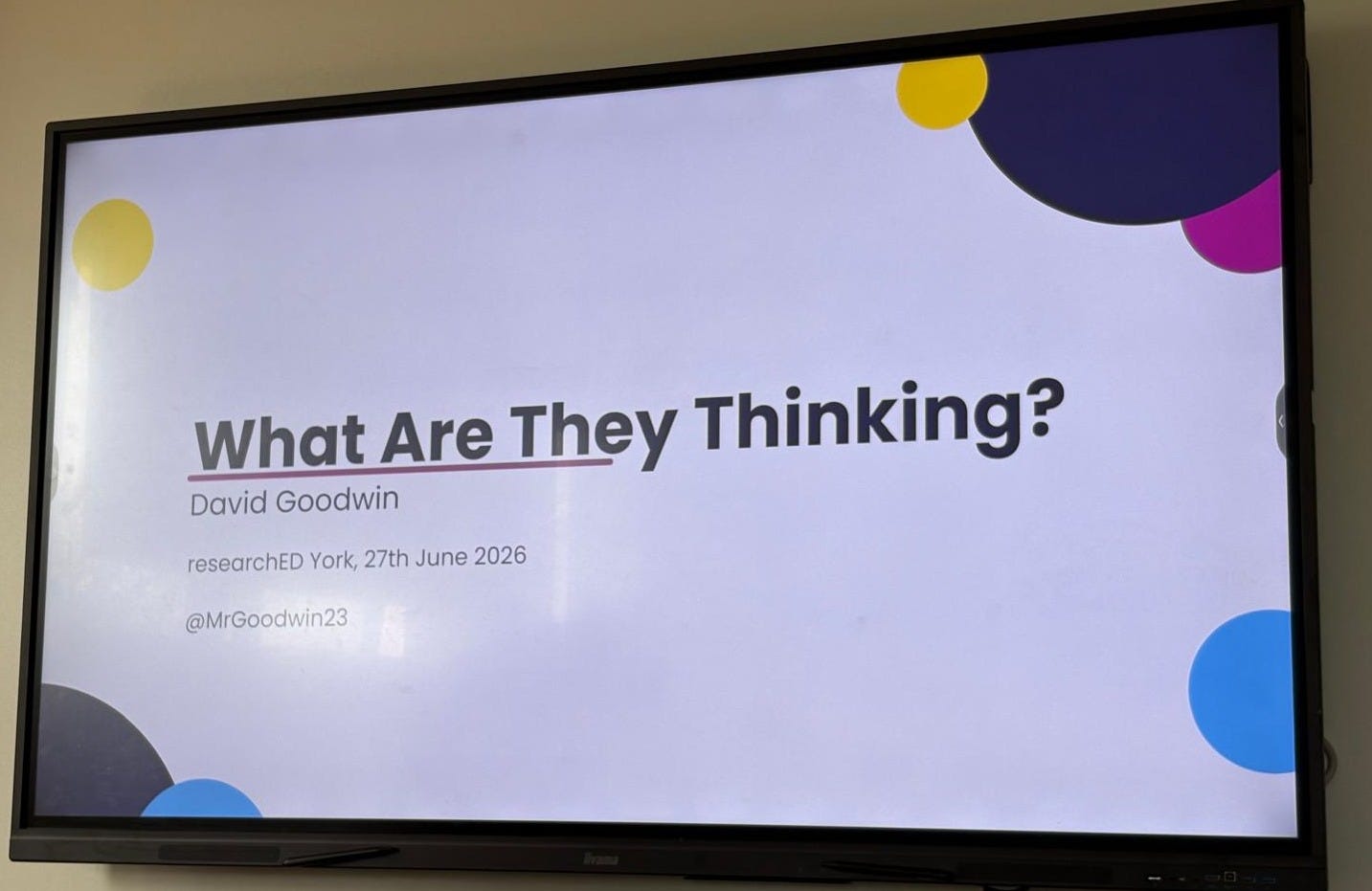
David’s talk at rEDYorkshire 2026 focused on one of the central problems of teaching: learning is invisible. As teachers, we cannot directly see what pupils have understood, misunderstood or only partially grasped. We can only infer this from the evidence pupils give us. This is why checking for understanding matters so much. It allows us to calibrate our teaching around what pupils actually know, rather than what we hope they know. In that sense, checking for understanding is what allows teaching to become responsive.
The problem with “OK?”
There was a ripple of laughter and recognition when David reminded us that most of us at some point in our teaching lives have followed up an explanation with questions such as: “OK?”, “Does that make sense?”, “Do you all understand?” or “Does anyone have any questions?”
The problem, of course, is that these questions do not give us particularly useful information. They do not tell us whether real understanding has developed. They also place too much responsibility on pupils to diagnose their own understanding at precisely the point where that understanding may be fragile, partial or misplaced.
As David highlighted, pupils do not know what they do not know. So asking “Do you understand?” is unlikely to reveal very much.
This matters because, without better evidence, we are making decisions in the dark. Do we move on? Do we pause? Do we re-explain? Do we model again? Do we give pupils more practice? David talked about the constant pressures teachers face to keep going: the curse of content coverage, the pressure to keep pace with others, rigid lesson structures, behaviour demands, and all the other practical realities of classroom life. These pressures are real, but they also make it even more important that we resist simply ploughing through. We need to build in regular checks for understanding so that teaching can remain responsive, rather than just delivered.
Reflecting on this for a moment, with my classroom practitioner hat on, it can be very easy to feel that we have covered something just because we have taught the lesson, completed the case study or moved through the scheme of work. But (unapologetically using geography examples) “covering” rivers, coasts, hazards, urbanisation or ecosystems is not the same as pupils understanding the processes, relationships and concepts that sit underneath. If we wait until the end-of-topic assessment to find out whether that understanding is secure, we may be too late. Misconceptions may already have become embedded, and pupils may have missed the crucial foundations they needed to make sense of what came next. By then, learning has been lost along the way: misunderstandings are harder to unpick, and gaps are harder to plug.
David also drew on Willingham’s idea that “memory is the residue of thought[1]. If we want pupils to learn, we need to think carefully about what they are thinking about. Checking for understanding is therefore not simply about catching errors. It is about creating the conditions in which all pupils are thinking about the thing that matters most.
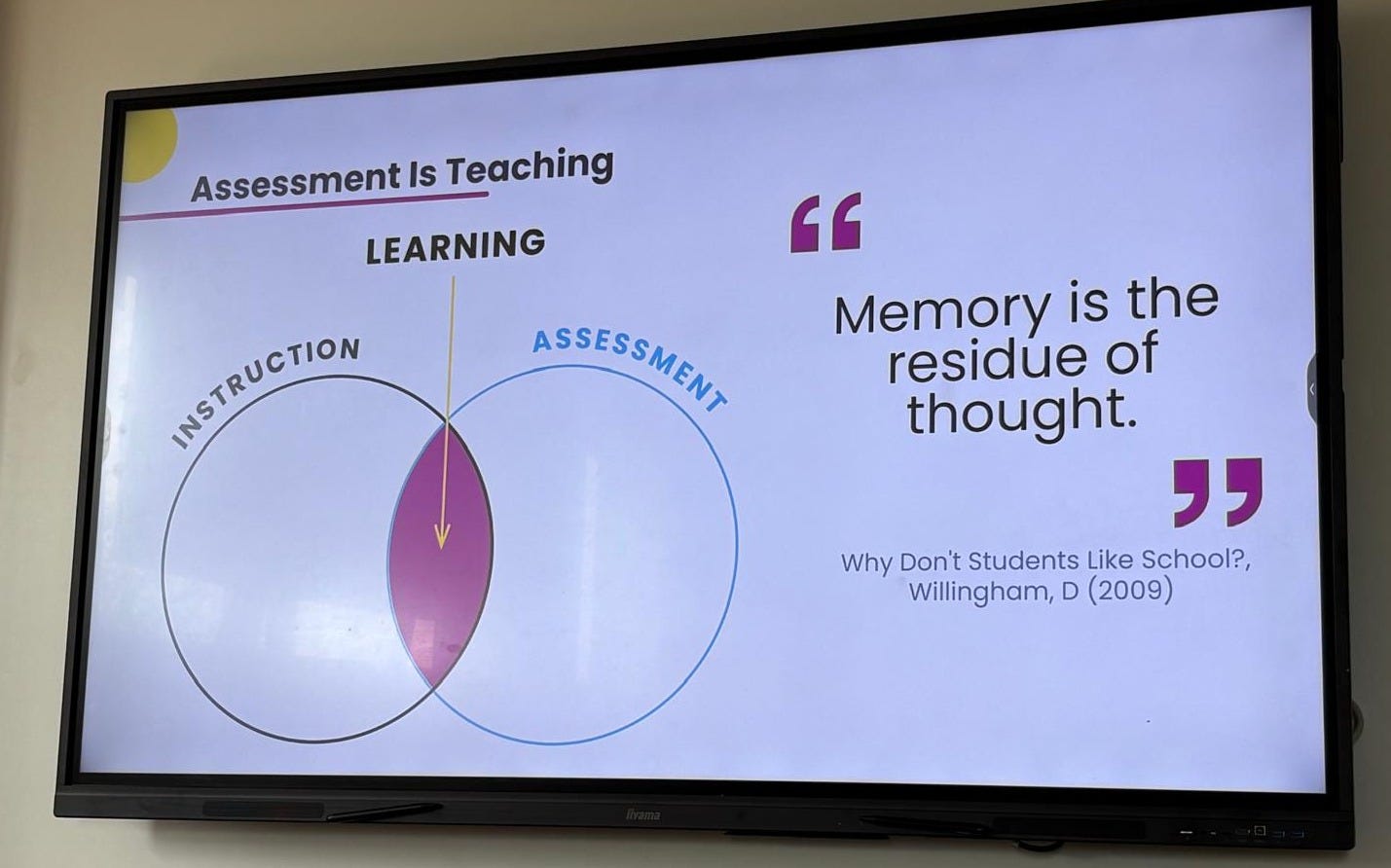
David also acknowledged the moral dimension to this. The cost of not checking, or of assuming understanding because the lesson appears to be going well, is not evenly distributed. Pupils with more prior knowledge, confidence, vocabulary or support may be better placed to navigate gaps or uncertainty. Those who are already most vulnerable to gaps in understanding are likely to lose out most.
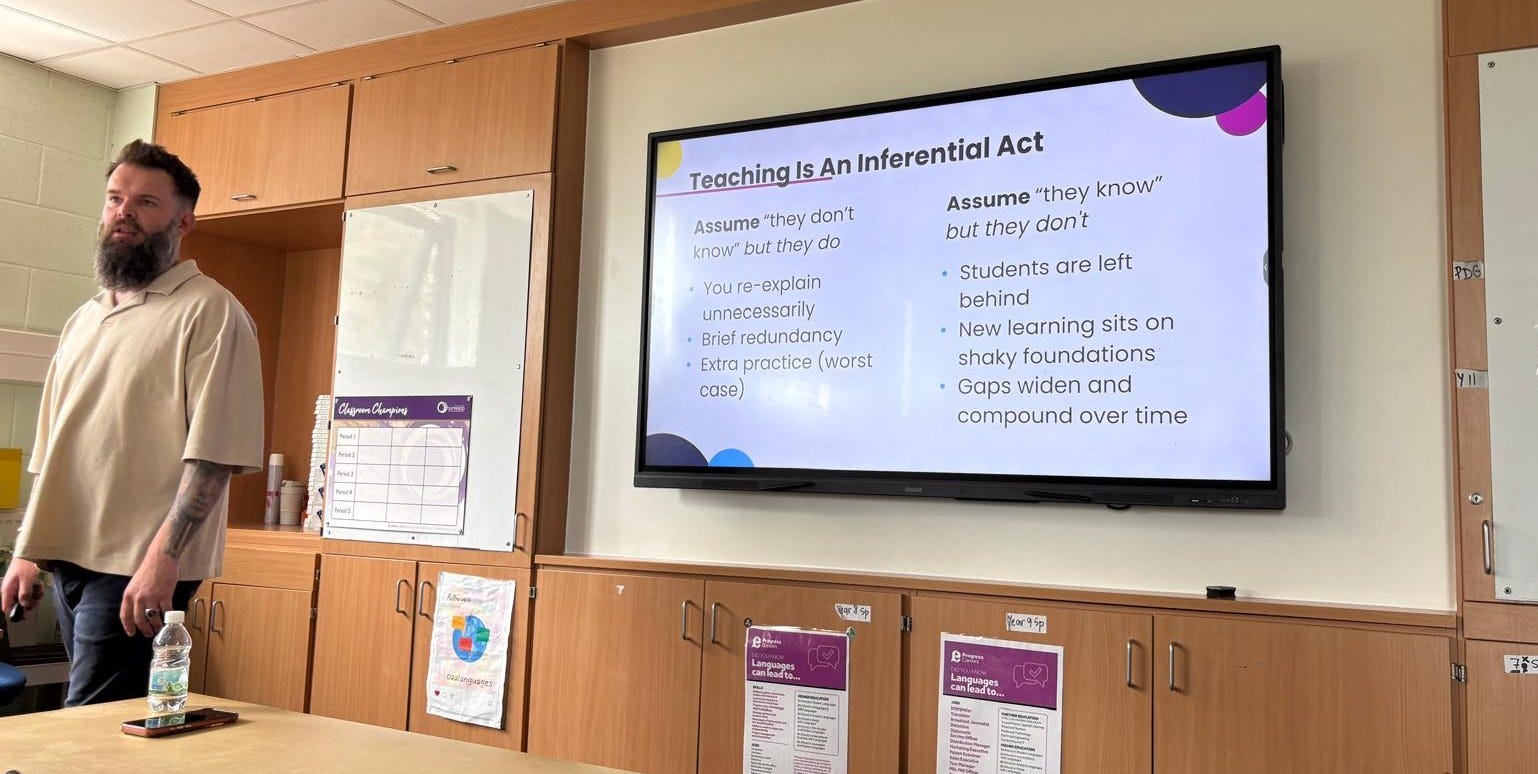
David emphasised that learning is invisible and teaching is extraordinarily complex. We can only infer understanding from the clues pupils give us, so we need to distinguish carefully between useful evidence and poor proxies. Busy work can look productive without producing learning. Compliance can look like understanding. Engagement can look like learning. A neat book can hide confusion. Even a correct answer from one pupil may not tell us much about what the rest of the class understands, or whether that one pupil’s understanding is secure.
Just as feedback can look like feedback without improving learning (see my reflection on Kate Jones’ talk), participation can look like learning without revealing understanding.
This means we need to be curious. Who in the room is least likely to know? Who is least likely to volunteer? Who may be masking uncertainty? Who has given the right answer but for the wrong reason? Who can repeat the words but not yet explain the idea?
In geography, this matters enormously. Pupils can often repeat the surface of an explanation, “rivers erode through abrasion, attrition and hydraulic action”, without really understanding what those processes are, what affects them, or how they shape the landscape over time. Checking for understanding helps us look beneath the surface of apparent understanding.
High thinking, high participation
David went on to talk about participation ratio and thinking ratio. This linked closely to some of the ideas that Caroline Spencer’s session on maximising questions drew on at ResearchEd Mildenhall, which I reflected on previously. The key point is that maximal learning is more likely when both thinking ratio and participation ratio are high: when as many pupils as possible are thinking hard and taking part.
With regard to thinking ratio, the quality of the questions matters enormously. We need carefully considered, challenging questions that make pupils think about the key idea, not just recall disconnected fragments. But in the middle of a lesson, teachers are under huge cognitive load. We are remembering the register, noticing who is stuck, managing behaviour, checking the time, remembering that one pupil has to leave early for a music lesson, collecting homework, adapting explanations, scanning the room and thinking about what comes next.
This is why planning questions before the lesson matters. It links directly to the importance of Intellectual Preparation.
Why the best checks begin before the lesson
For me, this is where David’s talk connected so strongly with the work I have been writing about on Intellectual Preparation, which I have previously explored in more detail in 3 linked posts here. If checking for understanding is how we make teaching responsive, then Intellectual Preparation is part of how we prepare ourselves to check well.
It starts with being clear about what we are actually teaching. What is the core knowledge pupils need to understand in this lesson? What is the concept, process, relationship or explanation that really matters? What prior knowledge will they need? What vocabulary needs to be secure? Where are pupils likely to stumble? What misconceptions are plausible? What might sound right but reveal a shaky understanding?
The better we understand the geography we are teaching, the more likely we are to anticipate the places where pupils may struggle: the plausible misconception, the missing prior knowledge, the vocabulary that sounds familiar but is not yet secure.
This is not about reducing teaching to a script. It is about preparing teachers to make better judgements in the moment. We plan questions, anticipate difficulty and think through participation structures so that, during the lesson, when our cognitive load is already high, we are better able to notice, interpret and respond to what pupils are actually thinking.
Good checking for understanding is therefore not just a technique. It is an intellectually prepared act.
David looked at three key strategies for checking for understanding in this session:
1. Cold Calling
2. Hinge Questions
3. Mini-Whiteboards
Cold calling: making more pupils think
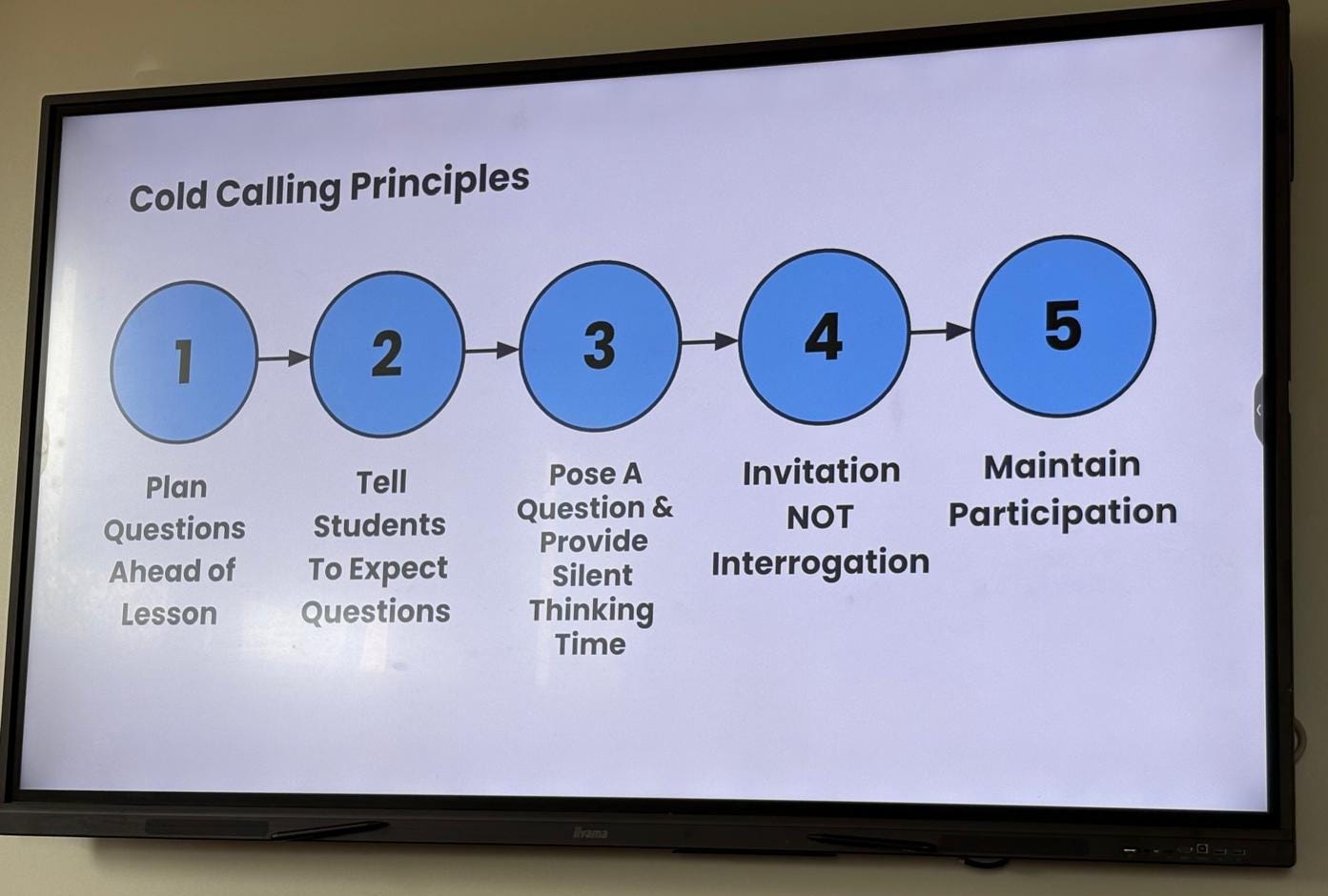
David discussed cold calling and the importance of wait time. This also linked back to points I have reflected on before in this post. If we ask a question and immediately take the first hand up, we may only be finding out what the quickest or most confident pupil is thinking. We are not necessarily increasing the thinking ratio of the room.
Wait time matters because it gives pupils time to think. Cold calling matters because it communicates that everyone is expected to think. Used well, it can help move questioning away from a small number of volunteers and towards wider participation.
But the culture around cold calling is crucial. It should not feel like a trap. David talked about warmly inviting pupils in: “What are you thinking?” rather than a more blunt “What is the answer?” That subtle shift matters. It frames the response as part of shared thinking, not a performance under threat.
He also suggested ways to make cold calling feel safer and more productive. We might pre-call or warm-call a pupil after seeing something useful in their book or on their whiteboard. We might circulate during independent work and identify pupils who have something worth sharing. We might use batched cold call so several pupils know they will be contributing. We might ask pupils to write first, pair-share, and then cold call, so they have had time to rehearse and refine their thinking before speaking publicly.
This made me think about the connection with classroom culture and, perhaps more cautiously, collective efficacy. I do not think cold calling is collective efficacy, but it does depend on a classroom culture where thinking, trying, being unsure and improving are normal parts of the collective work. Pupils need to feel that their thinking matters, and that uncertainty and error are treated as normal parts of learning, rather than something they need to hide.
2. Hinge questions: small questions, big decisions
David also explored hinge questions. These need careful thought and are a powerful example of why checking for understanding should be part of Intellectual Preparation.
As Harry Fletcher-Wood argues in Responsive Teaching [2], hinge questions are carefully designed multiple-choice questions in which each answer option reflects a possible error or line of reasoning. They are not simply quick recall checks. Done well, they allow pupils to demonstrate their understanding, partial understanding or misunderstanding at a critical point in the lesson.
This is why hinge questions need to be thought through carefully before the lesson. They sit at important junctions in learning. Can I move on? Do I need to clarify? Do I need to reteach? If pupils do not understand this idea, are they likely to struggle with what comes next?
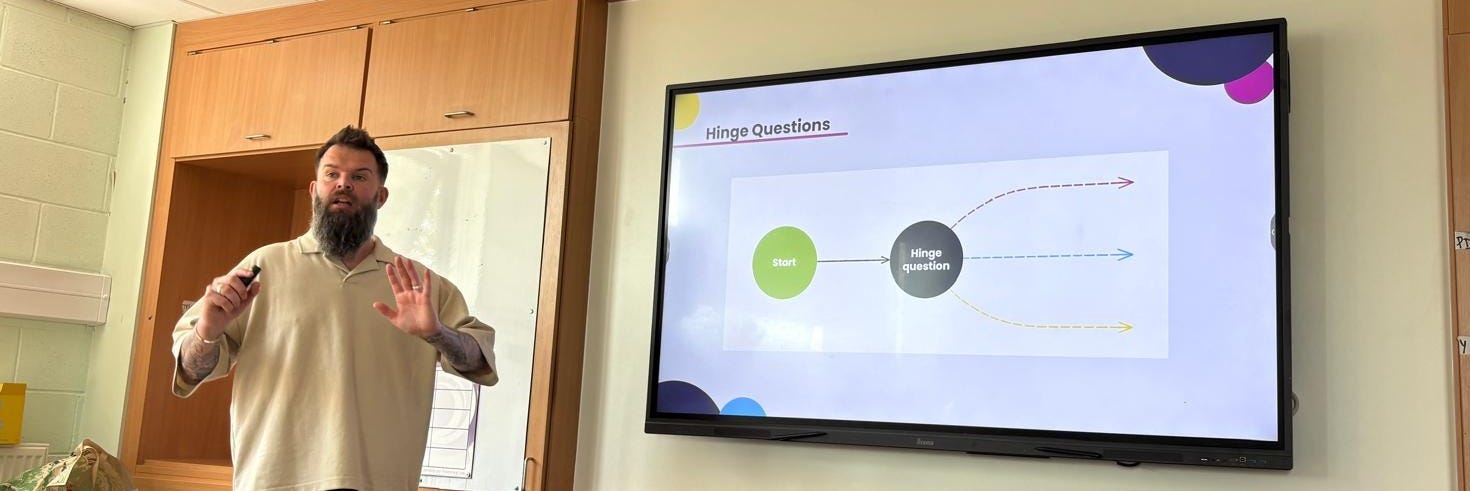
This connected strongly with David’s point about checking for understanding as a way of making teaching more responsive. Misunderstandings can become flawed foundations for future learning, so we need to actively seek them out early, before they become embedded. Checking for understanding is therefore not a pause before teaching continues. It is the point at which teaching becomes more intelligent.
In this sense, hinge questions mark important junctions. If pupils do not understand this idea, they are unlikely to understand what comes next. Misunderstandings become flawed foundations for future learning, so we need to actively seek them out early, before they become embedded.
Checking for understanding is therefore not a pause before teaching continues. It is the point at which teaching becomes more intelligent.
As a fellow geographer, I was of course pleased to see that David used a geographical example:
What is the capital of Brazil?
A. Rio de Janeiro
B. Brasília
C. São Paulo
This is a good example because the distractors are plausible. Rio de Janeiro is a common misconception, perhaps because of its historical and cultural prominence. São Paulo may reveal confusion between largest city and capital city. Brasília is the correct answer. The question does not simply test recall; it also reveals something about the misconception behind the answer.
That is the key to good hinge questions. The options need to be thought through carefully. The distractors should not be silly or obviously wrong. They should reveal something useful about pupils’ thinking.
David suggested that effective hinge questions should:
target one concept only
be unambiguous
include plausible distractors
suppress false positives
be fast to answer and quick to interpret
He also suggested rough thresholds for response. Around 80% correct may indicate that the teacher can move on, while following up with those who were unsure or incorrect. Between 40% and 80% may suggest confusion that needs clarification and re-checking. Less than 40% suggests the need to reteach.
The numbers are useful, but for me the bigger point is the decision-making. The hinge question is only powerful if the teacher responds to the evidence it produces.
Mini-whiteboards: making thinking visible
Unfortunately, David’s session ran out of time before we had the change to fully explore mini-whiteboards, so for transparency, this section is more my own reflection on how I have used them and why I think they are a particularly useful tool for checking for understanding. I would really welcome comments from others here, particularly additional reflections, practical routines, cautions or examples of how mini-whiteboards can be used well, and, just as importantly, what to avoid.
Mini-whiteboards can be powerful because they create high participation. Every pupil is expected to respond, and the teacher has a better chance of seeing what more pupils are thinking. Used well, they reduce the problem of only hearing from the pupils who are quickest, loudest or most confident.
But mini-whiteboards are only as useful as the questions we ask and the routines we establish.
A clear routine matters. The process needs to be slick and quick so that the boards give the teacher useful information without disrupting the flow of the lesson. I have often used the “hover, 1, 2, 3, show me” routine. Pupils hold their board down or hover it when they have written their answer, then everyone shows at the same time. This reduces copying and gives the teacher a clearer snapshot of the room.
The teacher then needs to scan deliberately. Who has it? Who does not? Is there a common misconception? Is the class split? Are there particular pupils I need to check in with? Are the errors random, or do they reveal something systematic?
This is another reason why question design matters. It is incredibly difficult to come up with high-quality, informative questions on the spot. We need to think in advance about what data we need and what kind of question will give us that data quickly.
The format of the response also matters. If pupils write long answers on whiteboards, it becomes very difficult to scan the room quickly. Often, for checking understanding, we want to reduce the amount pupils need to write so that the thinking is high but the written response is efficient.
This might mean:
one to five word answers
true or false
writing a letter for a multiple-choice answer
choosing between push or pull factors
identifying primary or secondary impacts
distinguishing physical and human causes
sequencing stages in a process
naming the process shown in a diagram
choosing whether an example is erosion, transportation or deposition
In geography, mini-whiteboards are particularly useful for checking distinctions. Can pupils distinguish push and pull factors in migration? Can they identify whether an impact is social, economic or environmental? Can they distinguish weathering from erosion? Can they tell whether a response to a hazard is immediate or long-term? Can they identify whether a piece of evidence supports physical or human causes of flooding? These checks help reveal whether pupils are using geographical terms with understanding, or simply recognising familiar words. If several pupils confuse the categories, that gives the teacher important evidence: the distinction may need reteaching, more modelling, or further examples before the class moves on.
Again, the point is not simply that every child has written something on a board. The point is that the teacher has gained better evidence about what the room understands.
Mini-whiteboards also work well in combination with other participation structures. Pupils can write before a cold call. They can jot down an idea before pair-share. They can commit to an answer before discussing it. In each case, the board helps make thinking more visible.
Final reflections
Running through David’s talk was the idea that the best checks for understanding do two things at once: they give the teacher better evidence, and they make pupils think harder about the thing that matters most.
But knowing and employing these checks for understanding is only the beginning. The professional judgement also comes in what happens next. Do we move on, clarify, re-question, model again, return to prior knowledge, offer more practice or reteach?
Again, this is where Intellectual Preparation matters. It is not simply about deciding in advance what the checks for understanding will be, or which participation structure we will use. Those things matter, but they sit within a wider process of anticipation. What might pupils already know? What might they not know? Where might they misunderstand? What explanation may need to be modelled again? What example might make the idea clearer? What scaffold might help without reducing the thinking? What would I do if a significant number of pupils do not understand?
We do not prepare simply so that we can deliver a lesson smoothly. We prepare so that we are better able to notice, interpret and respond to what pupils are actually thinking. Intellectual Preparation helps us think through the “what if?” moments before they happen: what we might need to model again, reteach, scaffold or practise further. But we can only make those decisions responsively if we have evidence of what pupils have and have not understood. That is why checking for understanding matters: it gives us the information we need to act on our preparation in the moment.
Checking for understanding is not an interruption to teaching. It is part of teaching. Without it, we risk teaching in the dark.
Keep an eye out for David’s new book, What Are They Thinking? The Ultimate Guide to Checking for Understanding, due out on 23 September. Not to be missed!
[1] Willingham, D. T. (2019) Why Don’t Students Like School? A Cognitive Scientist Answers Questions About How the Mind Works and What It Means for the Classroom. 2nd edn. San Francisco: Jossey-Bass.
[2] Fletcher-Wood, H. (2018). Responsive Teaching: Cognitive Science and Formative Assessment in Practice. Abingdon: Routledge.
understood, misunderstood or only partially grasped. We can only infer this from the evidence pupils give us. This is why checking for understanding matters so much. It allows us to calibrate our teaching around what pupils actually know, rather than what we hope they know. In that sense, checking for understanding is what allows teaching to become responsive.
The problem with “OK?”
There was a ripple of laughter and recognition when David reminded us that most of us at some point in our teaching lives have followed up an explanation with questions such as: “OK?”, “Does that make sense?”, “Do you all understand?” or “Does anyone have any questions?”
The problem, of course, is that these questions do not give us particularly useful information. They do not tell us whether real understanding has developed. They also place too much responsibility on pupils to diagnose their own understanding at precisely the point where that understanding may be fragile, partial or misplaced.
As David highlighted, pupils do not know what they do not know. So asking “Do you understand?” is unlikely to reveal very much.
This matters because, without better evidence, we are making decisions in the dark. Do we move on? Do we pause? Do we re-explain? Do we model again? Do we give pupils more practice? David talked about the constant pressures teachers face to keep going: the curse of content coverage, the pressure to keep pace with others, rigid lesson structures, behaviour demands, and all the other practical realities of classroom life. These pressures are real, but they also make it even more important that we resist simply ploughing through. We need to build in regular checks for understanding so that teaching can remain responsive, rather than just delivered.
Reflecting on this for a moment, with my classroom practitioner hat on, it can be very easy to feel that we have covered something just because we have taught the lesson, completed the case study or moved through the scheme of work. But (unapologetically using geography examples) “covering” rivers, coasts, hazards, urbanisation or ecosystems is not the same as pupils understanding the processes, relationships and concepts that sit underneath. If we wait until the end-of-topic assessment to find out whether that understanding is secure, we may be too late. Misconceptions may already have become embedded, and pupils may have missed the crucial foundations they needed to make sense of what came next. By then, learning has been lost along the way: misunderstandings are harder to unpick, and gaps are harder to plug.
David also drew on Willingham’s idea that “memory is the residue of thought[1]. If we want pupils to learn, we need to think carefully about what they are thinking about. Checking for understanding is therefore not simply about catching errors. It is about creating the conditions in which all pupils are thinking about the thing that matters most.
David also acknowledged the moral dimension to this. The cost of not checking, or of assuming understanding because the lesson appears to be going well, is not evenly distributed. Pupils with more prior knowledge, confidence, vocabulary or support may be better placed to navigate gaps or uncertainty. Those who are already most vulnerable to gaps in understanding are likely to lose out most.
David emphasised that learning is invisible and teaching is extraordinarily complex. We can only infer understanding from the clues pupils give us, so we need to distinguish carefully between useful evidence and poor proxies. Busy work can look productive without producing learning. Compliance can look like understanding. Engagement can look like learning. A neat book can hide confusion. Even a correct answer from one pupil may not tell us much about what the rest of the class understands, or whether that one pupil’s understanding is secure.
Just as feedback can look like feedback without improving learning (see my reflection on Kate Jones’ talk), participation can look like learning without revealing understanding.
This means we need to be curious. Who in the room is least likely to know? Who is least likely to volunteer? Who may be masking uncertainty? Who has given the right answer but for the wrong reason? Who can repeat the words but not yet explain the idea?
In geography, this matters enormously. Pupils can often repeat the surface of an explanation, “rivers erode through abrasion, attrition and hydraulic action”, without really understanding what those processes are, what affects them, or how they shape the landscape over time. Checking for understanding helps us look beneath the surface of apparent understanding.
High thinking, high participation
David went on to talk about participation ratio and thinking ratio. This linked closely to some of the ideas that Caroline Spencer’s session on maximising questions drew on at ResearchEd Mildenhall, which I reflected on previously. The key point is that maximal learning is more likely when both thinking ratio and participation ratio are high: when as many pupils as possible are thinking hard and taking part.
With regard to thinking ratio, the quality of the questions matters enormously. We need carefully considered, challenging questions that make pupils think about the key idea, not just recall disconnected fragments. But in the middle of a lesson, teachers are under huge cognitive load. We are remembering the register, noticing who is stuck, managing behaviour, checking the time, remembering that one pupil has to leave early for a music lesson, collecting homework, adapting explanations, scanning the room and thinking about what comes next.
This is why planning questions before the lesson matters. It links directly to the importance of Intellectual Preparation.
Why the best checks begin before the lesson
For me, this is where David’s talk connected so strongly with the work I have been writing about on Intellectual Preparation, which I have previously explored in more detail in 3 linked posts here. If checking for understanding is how we make teaching responsive, then Intellectual Preparation is part of how we prepare ourselves to check well.
It starts with being clear about what we are actually teaching. What is the core knowledge pupils need to understand in this lesson? What is the concept, process, relationship or explanation that really matters? What prior knowledge will they need? What vocabulary needs to be secure? Where are pupils likely to stumble? What misconceptions are plausible? What might sound right but reveal a shaky understanding?
The better we understand the geography we are teaching, the more likely we are to anticipate the places where pupils may struggle: the plausible misconception, the missing prior knowledge, the vocabulary that sounds familiar but is not yet secure.
This is not about reducing teaching to a script. It is about preparing teachers to make better judgements in the moment. We plan questions, anticipate difficulty and think through participation structures so that, during the lesson, when our cognitive load is already high, we are better able to notice, interpret and respond to what pupils are actually thinking.
Good checking for understanding is therefore not just a technique. It is an intellectually prepared act.
David looked at three key strategies for checking for understanding in this session:
1. Cold Calling
2. Hinge Questions
3. Mini-Whiteboards
Cold calling: making more pupils think
David discussed cold calling and the importance of wait time. This also linked back to points I have reflected on before in this post. If we ask a question and immediately take the first hand up, we may only be finding out what the quickest or most confident pupil is thinking. We are not necessarily increasing the thinking ratio of the room.
Wait time matters because it gives pupils time to think. Cold calling matters because it communicates that everyone is expected to think. Used well, it can help move questioning away from a small number of volunteers and towards wider participation.
But the culture around cold calling is crucial. It should not feel like a trap. David talked about warmly inviting pupils in: “What are you thinking?” rather than a more blunt “What is the answer?” That subtle shift matters. It frames the response as part of shared thinking, not a performance under threat.
He also suggested ways to make cold calling feel safer and more productive. We might pre-call or warm-call a pupil after seeing something useful in their book or on their whiteboard. We might circulate during independent work and identify pupils who have something worth sharing. We might use batched cold call so several pupils know they will be contributing. We might ask pupils to write first, pair-share, and then cold call, so they have had time to rehearse and refine their thinking before speaking publicly.
This made me think about the connection with classroom culture and, perhaps more cautiously, collective efficacy. I do not think cold calling is collective efficacy, but it does depend on a classroom culture where thinking, trying, being unsure and improving are normal parts of the collective work. Pupils need to feel that their thinking matters, and that uncertainty and error are treated as normal parts of learning, rather than something they need to hide.
2. Hinge questions: small questions, big decisions
David also explored hinge questions. These need careful thought and are a powerful example of why checking for understanding should be part of Intellectual Preparation.
As Harry Fletcher-Wood argues in Responsive Teaching [2], hinge questions are carefully designed multiple-choice questions in which each answer option reflects a possible error or line of reasoning. They are not simply quick recall checks. Done well, they allow pupils to demonstrate their understanding, partial understanding or misunderstanding at a critical point in the lesson.
This is why hinge questions need to be thought through carefully before the lesson. They sit at important junctions in learning. Can I move on? Do I need to clarify? Do I need to reteach? If pupils do not understand this idea, are they likely to struggle with what comes next?
This connected strongly with David’s point about checking for understanding as a way of making teaching more responsive. Misunderstandings can become flawed foundations for future learning, so we need to actively seek them out early, before they become embedded. Checking for understanding is therefore not a pause before teaching continues. It is the point at which teaching becomes more intelligent.
In this sense, hinge questions mark important junctions. If pupils do not understand this idea, they are unlikely to understand what comes next. Misunderstandings become flawed foundations for future learning, so we need to actively seek them out early, before they become embedded.
Checking for understanding is therefore not a pause before teaching continues. It is the point at which teaching becomes more intelligent.
As a fellow geographer, I was of course pleased to see that David used a geographical example:
What is the capital of Brazil?
A. Rio de Janeiro
B. Brasília
C. São Paulo
This is a good example because the distractors are plausible. Rio de Janeiro is a common misconception, perhaps because of its historical and cultural prominence. São Paulo may reveal confusion between largest city and capital city. Brasília is the correct answer. The question does not simply test recall; it also reveals something about the misconception behind the answer.
That is the key to good hinge questions. The options need to be thought through carefully. The distractors should not be silly or obviously wrong. They should reveal something useful about pupils’ thinking.
David suggested that effective hinge questions should:
target one concept only
be unambiguous
include plausible distractors
suppress false positives
be fast to answer and quick to interpret
He also suggested rough thresholds for response. Around 80% correct may indicate that the teacher can move on, while following up with those who were unsure or incorrect. Between 40% and 80% may suggest confusion that needs clarification and re-checking. Less than 40% suggests the need to reteach.
The numbers are useful, but for me the bigger point is the decision-making. The hinge question is only powerful if the teacher responds to the evidence it produces.
Mini-whiteboards: making thinking visible
Unfortunately, David’s session ran out of time before we had the change to fully explore mini-whiteboards, so for transparency, this section is more my own reflection on how I have used them and why I think they are a particularly useful tool for checking for understanding. I would really welcome comments from others here, particularly additional reflections, practical routines, cautions or examples of how mini-whiteboards can be used well, and, just as importantly, what to avoid.
Mini-whiteboards can be powerful because they create high participation. Every pupil is expected to respond, and the teacher has a better chance of seeing what more pupils are thinking. Used well, they reduce the problem of only hearing from the pupils who are quickest, loudest or most confident.
But mini-whiteboards are only as useful as the questions we ask and the routines we establish.
A clear routine matters. The process needs to be slick and quick so that the boards give the teacher useful information without disrupting the flow of the lesson. I have often used the “hover, 1, 2, 3, show me” routine. Pupils hold their board down or hover it when they have written their answer, then everyone shows at the same time. This reduces copying and gives the teacher a clearer snapshot of the room.
The teacher then needs to scan deliberately. Who has it? Who does not? Is there a common misconception? Is the class split? Are there particular pupils I need to check in with? Are the errors random, or do they reveal something systematic?
This is another reason why question design matters. It is incredibly difficult to come up with high-quality, informative questions on the spot. We need to think in advance about what data we need and what kind of question will give us that data quickly.
The format of the response also matters. If pupils write long answers on whiteboards, it becomes very difficult to scan the room quickly. Often, for checking understanding, we want to reduce the amount pupils need to write so that the thinking is high but the written response is efficient.
This might mean:
one to five word answers
true or false
writing a letter for a multiple-choice answer
choosing between push or pull factors
identifying primary or secondary impacts
distinguishing physical and human causes
sequencing stages in a process
naming the process shown in a diagram
choosing whether an example is erosion, transportation or deposition
In geography, mini-whiteboards are particularly useful for checking distinctions. Can pupils distinguish push and pull factors in migration? Can they identify whether an impact is social, economic or environmental? Can they distinguish weathering from erosion? Can they tell whether a response to a hazard is immediate or long-term? Can they identify whether a piece of evidence supports physical or human causes of flooding? These checks help reveal whether pupils are using geographical terms with understanding, or simply recognising familiar words. If several pupils confuse the categories, that gives the teacher important evidence: the distinction may need reteaching, more modelling, or further examples before the class moves on.
Again, the point is not simply that every child has written something on a board. The point is that the teacher has gained better evidence about what the room understands.
Mini-whiteboards also work well in combination with other participation structures. Pupils can write before a cold call. They can jot down an idea before pair-share. They can commit to an answer before discussing it. In each case, the board helps make thinking more visible.
Final reflections
Running through David’s talk was the idea that the best checks for understanding do two things at once: they give the teacher better evidence, and they make pupils think harder about the thing that matters most.
But knowing and employing these checks for understanding is only the beginning. The professional judgement also comes in what happens next. Do we move on, clarify, re-question, model again, return to prior knowledge, offer more practice or reteach?
Again, this is where Intellectual Preparation matters. It is not simply about deciding in advance what the checks for understanding will be, or which participation structure we will use. Those things matter, but they sit within a wider process of anticipation. What might pupils already know? What might they not know? Where might they misunderstand? What explanation may need to be modelled again? What example might make the idea clearer? What scaffold might help without reducing the thinking? What would I do if a significant number of pupils do not understand?
We do not prepare simply so that we can deliver a lesson smoothly. We prepare so that we are better able to notice, interpret and respond to what pupils are actually thinking. Intellectual Preparation helps us think through the “what if?” moments before they happen: what we might need to model again, reteach, scaffold or practise further. But we can only make those decisions responsively if we have evidence of what pupils have and have not understood. That is why checking for understanding matters: it gives us the information we need to act on our preparation in the moment.
Checking for understanding is not an interruption to teaching. It is part of teaching. Without it, we risk teaching in the dark.
Keep an eye out for David’s new book, What Are They Thinking? The Ultimate Guide to Checking for Understanding, due out on 23 September. Not to be missed!
[1] Willingham, D. T. (2019) Why Don’t Students Like School? A Cognitive Scientist Answers Questions About How the Mind Works and What It Means for the Classroom. 2nd edn. San Francisco: Jossey-Bass.
[2] Fletcher-Wood, H. (2018). Responsive Teaching: Cognitive Science and Formative Assessment in Practice. Abingdon: Routledge.